A strategy turns into action when every priority has a measurable target, a single named owner, the resources to deliver it and a regular review that resets it. Most plans fail in the gap between the strategy day and Monday morning, not in the thinking. At Klicx we work in that gap: our business assessment shows where an organisation stands, and our training and implementation support build the capability to close the distance.
This guide gives you the routine step by step, with the points where it usually goes wrong.
TL;DR
- Boil the strategy down to one page with one measurable objective, a target date, a defined scope and your advantage.
- Convert it into a scorecard, then into actions with SMART objectives and one accountable owner each.
- Cascade goals from the organisation to teams and individuals so daily work visibly serves the plan.
- Run 90-day cycles with quarterly reviews, and expect to adjust as assumptions change.
- Build the skills to execute: process improvement and assessment capability turn a plan into results.
Table of Contents
- Why good strategies stall
- Step 1: Write the strategy on one page
- Step 2: Build a scorecard from the statement
- Step 3: Turn priorities into actions, measures and owners
- Step 4: Cascade the plan into team and individual goals
- Step 5: Set the routines that keep it moving
- Step 6: Measure progress and adapt
- The capability behind execution
- Where Klicx comes in
- Our perspective
- FAQ
- Sources
Why good strategies stall
Most leadership teams can say what they want to achieve. Fewer can say who is doing what by when, and how they will know it is working. Strategy documents tend to describe direction. Execution needs decisions about priorities, people and money, and those decisions are uncomfortable because they mean saying no to some good ideas.
The place to see whether a strategy is real is the systems that run the organisation. A BusinessNZ dashboard from August 2026, drawing on 96 chief executives, reports that between 65% and 72% integrate core strategy into hiring, promotion, succession and KPIs. For culture the range is 43% to 47%, and for sustainability 33% to 40%. In other words, strategy gets embedded in the levers that shape behaviour in many NZ organisations, but not everywhere, and the further a priority sits from those levers, the less likely it is to move.
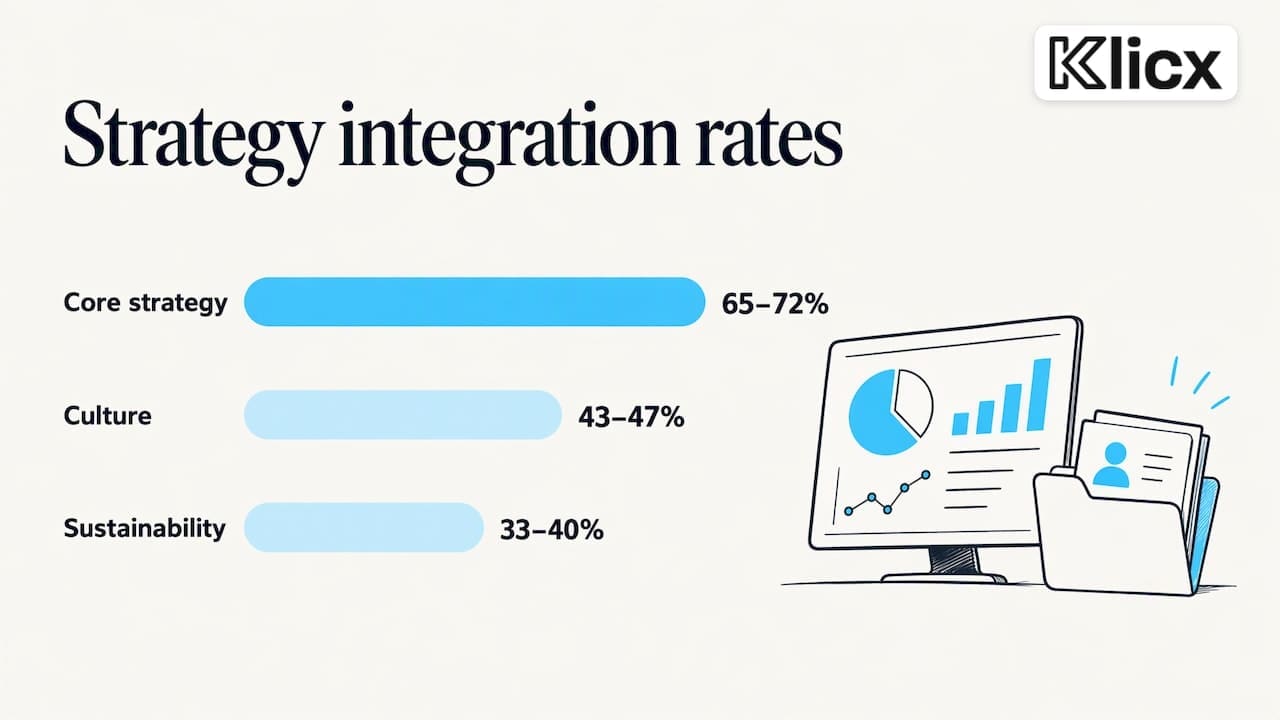
That is the practical test for the steps below. If a priority does not show up in someone’s goals, a budget line or a regular meeting, it is not yet an action.
Step 1: Write the strategy on one page
A strategy that cannot be explained quickly cannot be acted on. Business.govt.nz recommends a one-page strategy statement with a single specific, measurable objective and a target date, a defined scope, and your advantage. You then use the statement to communicate the strategy and to test everything you do against it.
Where it goes wrong:
- Several objectives pretending to be one. If the statement has five goals, teams will pick the one that suits them. Choose the one that matters most this period.
- Vague wording. “Grow our market presence” cannot be tested. “Lift repeat-customer revenue by 15% by 30 June 2028” can.
- No scope. Without a line on what you will not do, every request looks like part of the strategy.
The test question for any project or request is simple: does it move the objective, inside the scope, using the advantage we claim? If not, it waits.
Step 2: Build a scorecard from the statement
A single objective is too blunt to manage week to week. Business.govt.nz suggests building a strategy scorecard from the statement, with categories, detailed objectives, measures, targets and actions. Its categories are finances, customers and stakeholders, internal processes, and innovation and learning, and its example of a numeric target is a sales increase of “20% by value” over last year.
A short worked example shows how it fits together. Imagine a Hamilton food manufacturer whose objective is to double export revenue in three years:
| Category | Objective | Measure | Target |
|---|---|---|---|
| Finances | Grow export margin | Gross margin on export lines | Agreed percentage by year end |
| Customers | Win repeat buyers offshore | Repeat orders per account | Agreed number per quarter |
| Internal processes | Cut order-to-dispatch time | Days from order to dispatch | Agreed reduction |
| Innovation and learning | Build process improvement skills | Staff trained and projects completed | Agreed number |
The figures here are illustrative: the point is that each row has a measure and a number, and the internal-process and learning rows explain how the finance and customer rows will actually be reached. Keep the scorecard to a page, with a handful of measures per category. A longer one will not be read.
Step 3: Turn priorities into actions, measures and owners
This is the step where plans most often go soft. The University of Otago’s implementation plan guidelines (December 2023) lay out a sequence that works in any organisation, not just a university:
- Agree the core strategic aims.
- Identify the key actions for each aim, in priority order.
- Identify measures and KPIs for each action, and when you will measure them.
- Set SMART objectives: specific, measurable, achievable, relevant and time-bound, stating what is to be achieved and by when.
- Allocate one accountable owner per key action.
- Allocate people, physical and financial resources, and identify the gaps.
- Communicate the plan to stakeholders.
- Review and update continuously.
The guidelines describe the plan as a roadmap from where you are now to where you want to be, and make the point that producing the plan is not the end of implementation.
Two failure points deserve attention. The first is shared ownership. A committee owning an action means nobody does, so one name goes against each action, even when many people contribute. The second is the resource gap. Step 6 asks you to identify gaps, and that means admitting when the people or budget do not exist. A plan with ten actions and capacity for six is really a plan with six actions, and it is better to choose which six than to let them be chosen by whoever shouts loudest.
Step 4: Cascade the plan into team and individual goals
People act on what is in their own goals. The University of Waikato’s staff performance policy shows a clear cascade: a three to five year organisational strategic plan feeds division and team plans, reviewed annually, which feed individual goals and objectives. The approach runs both top-down and bottom-up, with each layer contributing to the plan and taking responsibility for the goals relevant to it, and the output is documented plans with measurable goals.
For a business with 20 or 200 staff, the same logic means:
- Each team lead can state which scorecard line their team moves.
- Each person’s goals include at least one item that traces back to the plan.
- Teams are invited to say what is unrealistic. The bottom-up part matters: the people doing the work know where the process is slow or broken.
If you cannot draw a line from someone’s weekly work to the strategy, either the work is not needed or the strategy has not reached them.
Step 5: Set the routines that keep it moving
Plans lose momentum when nobody looks at them. The March 2026 performance improvement review of Te Aho o Te Kahu, the cancer control agency, recommends rolling quarterly or 90-day plans to drive focus, prioritisation and accountability aligned to strategy. These are monitored through regular performance conversations, with formal quarterly reviews to reflect on learnings, identify risks and opportunities, and reset priorities.
A 90-day cycle suits most NZ organisations because it is short enough to stay real and long enough to finish something. Each quarter you pick the few actions that matter most, assign them, and review at the end.
For the conversations themselves, the Waikato policy uses a simple structure called GOOD: Goals (where things stand since the last meeting), Obstacles, Opportunities and Decisions (agree next steps and who is responsible). The written summary records whether each goal was not completed, partially completed, completed, surpassed or no longer applicable. That last category is useful, because it gives managers permission to retire a goal when circumstances have changed instead of dragging it along. The policy sets reflection at twice a year as standard, with quarterly reflections in fast-paced environments, which is a good reason to treat quarterly as your minimum for strategy actions.
A GOOD conversation takes twenty minutes and produces a decision, not a status report. If your meetings end without a named next step, they are not doing this job.
When the actions involve automating workflows or adopting AI tools, decide early whether you need a full engagement or a small trial. This guide on choosing an AI strategy consultant sets out how to make that call so the agreed actions stay proportionate.

Step 6: Measure progress and adapt
Tracking is not only about checking boxes. The Otago guidelines note that successful organisations monitor actual performance against the plan and are ready to adjust as assumptions prove wrong and the competitive environment changes. The Te Aho o Te Kahu review similarly pairs quarterly resets with a cascade of metrics from vision and purpose down to capability outcomes.
A few practical rules follow:
- Limit the strategic indicators. The EFQM Model 2025 separates strategic performance, the results of executing strategic initiatives, from operational performance, the day-to-day outcomes, and keeps strategic indicators to a limited number of key measures. Mixing the two buries the signal.
- Choose measures with care. A framework from the Council of Environmental Organisations in its leading practices paper says KPI choice determines what management focuses on, and that a board should regularly evaluate implementation progress while planned and emergent strategy develop together.
- Give measurement time. A Waikato University case study of a fisheries holding company found that developing KPIs took six months and surfaced reluctance to move beyond financial measures, disagreements across functional boundaries and managers avoiding fixing responsibility. Expect the same friction and plan for it.
An NZ study by Massey University and AUT of 102 construction professionals found that how decisions are formulated, implemented and evaluated were all significant predictors of business performance, alongside financial strength. Execution practices and evaluation sit in that list for a reason: they are part of the strategy, not an afterthought.
The capability behind execution
Routines only work if people can improve the way work is done. Your scorecard’s internal-process line, such as cutting dispatch time or reducing rework, needs staff who can map a process, find the cause of delay and fix it without making things worse elsewhere. That is the skill set Lean Six Sigma develops, and it is why we train staff in it as part of our improvement work.
The same applies to assessment. Knowing where you stand against a recognised framework gives the one-page statement something solid to rest on. We use the EFQM framework to combine assessment, capability building and practical implementation, so leaders see the gaps and their teams learn to close them.
Here is how that maps to the steps above:
| Step | What helps | Where we fit |
|---|---|---|
| Statement and scorecard | An honest view of current performance | Business assessment and assessment support |
| Actions and owners | Project discipline and clear delivery plans | Innovation and project management |
| Process results | Staff who can improve processes | Lean Six Sigma training |
| Systems and workflow | Integration that supports the plan | Digital solutions, described on what we do |
If you want more on how improvement work fits around a plan, our guides on performance improvement consulting and project management support go deeper.
Where Klicx comes in
If your plan is written but the results are not arriving, start by building a shared understanding of the gap. Our business improvement work covers consulting, training and implementation support for NZ organisations, from small businesses to large corporates.
For teams building the skills in-house, our course range on the courses page is priced per person. The Lean White Belt Optimisation Foundation Course starts from NZ$795, the Lean Six Sigma Yellow Belt from NZ$1,500 and the Green Belt from NZ$3,345. Sponsors and champions can take the Lean for Leaders course from NZ$495. For assessment skills, the EFQM Foundation Course Fast Track starts from NZ$795, the In-Depth version from NZ$1,500 and the 4-day Assessor Course from NZ$3,345.

Pick the route that matches your next 90 days: a business assessment to find where the plan is stuck, or training for the people who will own the actions.
Our perspective
We see the same pattern in strategy work across NZ organisations: leaders agree on direction, then the plan sits in a document while the business carries on as before. The cure is rarely a better strategy. It is a smaller set of priorities, a named owner for each, and people with the skills to change how work gets done.
That is why we combine assessment, capability building and implementation support instead of offering any one on its own. An assessment tells you where you stand. Training in Lean Six Sigma and EFQM gives your teams the confidence to act on what it shows. Practical implementation support keeps the 90-day cycle turning when the day job gets busy.
Our advice is to treat execution as a capability you build, not a project you run once. Organisations that make improvement part of how they work find the next strategy easier to deliver than the last.
Jeremy
FAQ
How long should a strategy action plan cover?
Keep the strategy horizon as long as your objective needs, often three years, but plan the actions in 90-day cycles. The Te Aho o Te Kahu review recommends rolling quarterly or 90-day plans with formal quarterly reviews. Each quarter you reset priorities using what you learned.
Who should own each action?
One individual, not a team. The Otago guidelines call for a single accountable owner per key action, with resources allocated and gaps identified. Others can contribute, but one person answers for the result.
How many measures should a scorecard have?
Few enough that leaders actually discuss them. Business.govt.nz suggests grouping measures under finances, customers and stakeholders, internal processes, and innovation and learning, each with a numeric target. A handful per category is a workable ceiling, and strategic indicators should stay limited.
What if results or circumstances change mid-year?
Adjust the plan, not just the excuses. Successful organisations monitor performance against the plan and change it as assumptions prove wrong. Use your quarterly review to reset priorities, and mark goals that no longer apply as retired.
Sources
- Turning strategy into action, Business.govt.nz
- Implementation plan guidelines, University of Otago
- Staff performance and professional development policy, University of Waikato
- Performance improvement review of Te Aho o Te Kahu, March 2026
- BusinessNZ Dashboard, August 2026
- Implementing strategic initiatives: a framework of leading practices
- Decisions That Build: Strategic Decision-Making, Massey University
- Fisheries holding company KPI case study, University of Waikato
Recommended
- Business Strategy Consulting in NZ: What It Is and How to Choose
- Operational Efficiency Improvement: A Practical Guide for NZ Organisations
- Change Leadership Training for NZ Organisations
- Reducing Operational Costs: A Practical Plan for NZ Organisations
This article was produced with AI assistance and reviewed for accuracy. It is provided for general information only and is not professional advice.