Operational excellence training teaches your people to find where work is slowed by waste, rework or unclear process, and to fix it with proven methods. It pays off when the course matches the role, and when it is tied to a real improvement project and a way of measuring the result. Klicx runs Lean Six Sigma and EFQM courses for New Zealand organisations, from a NZ$795 introduction to a NZ$3,345 Green Belt, alongside assessment and implementation support.
TL;DR
- Operational excellence training covers how to analyse operational problems, apply improvement methods such as PDCA, Kaizen and DMAIC, and measure the outcome.
- Match the level to the role: awareness for sponsors and teams, Yellow Belt for contributors, Green Belt for people who lead projects, EFQM courses for those assessing the whole organisation.
- New Zealand evidence, including Auckland City Hospital’s Lean Six Sigma programme, shows what trained staff running their own projects can achieve.
- Training sticks when it is tied to a live project, a sponsor and a measure agreed before the course starts.
Table of Contents
- What operational excellence training actually is
- What a solid course should cover
- Qualifications on the New Zealand map
- Which level for which person
- What trained staff have achieved in New Zealand
- Making training stick and measuring the result
- Perspective
- Where Klicx fits
- FAQ
- Sources
What operational excellence training actually is
Operational excellence is the habit of running an organisation so that the work customers value flows smoothly, and of improving that flow continuously rather than in occasional crisis projects. Training is how you build that habit into more than one or two people. Instead of relying on an outside team to fix a process once, you give your own staff the tools to find the problem, test a change and prove it worked.
For a New Zealand manager, the practical questions are usually these. Where is time or money leaking? Which of our processes depend on one person’s memory? Why do the same errors keep returning? Operational excellence courses give structured ways to answer each one. The two families Klicx teaches are Lean Six Sigma, which focuses on removing waste and reducing variation in processes, and the EFQM Model, a framework for assessing how the whole organisation performs, from strategy and leadership to results.
The courses you see ranked for this term range widely: general operations management programmes, short online workshops and multi-day instructor-led courses. The difference that matters for your organisation is whether the course ends with a certificate or with a changed process. The rest of this article is about getting the second outcome.
What a solid course should cover
The clearest New Zealand reference for content is the skill standard NZQA publishes for operational-level improvement. NZQA skill standard 40914 is a Level 5, 15-credit standard on analysing operational issues and applying continuous improvement techniques. It is aimed at people in, or heading towards, operational-level leadership. It is useful as a checklist even if your course is not formally linked to it.
According to the standard, learners should be able to analyse operational issues and their impact on organisational performance using tools such as surveys, SWOT, SOAR, risk registers and root cause analysis. They then apply improvement techniques including total quality management, Kanban, PDCA (plan, do, check, act), Kaizen, DMAIC (define, measure, analyse, improve, control), benchmarking and continuous feedback loops.
The same standard asks learners to look at both sides of the business:
- Internal impacts: process efficiency, quality, cost control, change management and staff productivity.
- External impacts: the labour market, regulation, supply chains, customer trends and sustainability.
When you compare courses, look for these four things:
- A method with a name. DMAIC, PDCA or the EFQM assessment cycle, not just “efficiency tips”.
- Root cause tools. Anyone can brainstorm solutions; trained people first establish what is really causing the problem.
- Measurement. A course should show how to set a baseline and check the result after the change.
- A project. Practice on your own process is worth more than a case study about someone else’s.
Qualifications on the New Zealand map
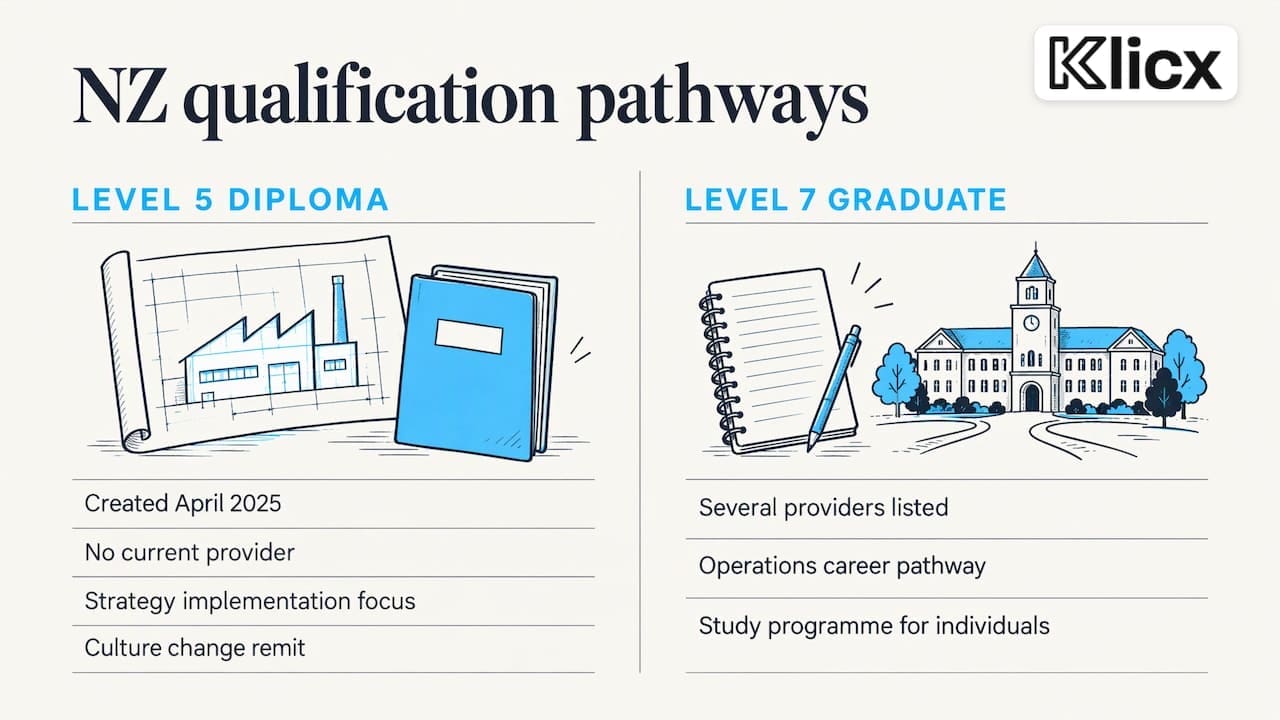
There is a formal New Zealand pathway, but it is new. NZQA lists the New Zealand Diploma in Operational Excellence (Competitive Systems and Practices) at Level 5, a 120-credit qualification created in April 2025 and developed by the Manufacturing & Engineering Industry Skills Board. Its purpose is to give businesses implementing an operational excellence strategy people who can carry it out and drive culture change. Graduates are expected to analyse a workplace value chain, plan and lead implementation, measure and review results afterwards, and shape the culture around the change.
The NZQA overview also notes that no education organisation currently offers that diploma. For most organisations, the practical route today is therefore skills-based training in recognised methods, delivered close to your own processes, with the formal diploma as a longer-term option to watch.
At the other end, NZQA’s search lists Level 7 Graduate Diplomas in Operations and Production Management of 120 credits at several polytechnics and institutes, including Ara, Otago Polytechnic, Manukau Institute of Technology, Unitec, Waikato Institute of Technology, NZIST and UCOL. These are study programmes for individuals building a long-term operations career. They suit that purpose well. A manager who needs a team capable of improving a process this quarter generally needs a shorter, applied course.
Which level for which person
The most common mistake in buying training is sending everyone to the same course. A better approach is to treat the organisation as layers, each needing something different.
Sponsors and executives
The people who approve projects and remove obstacles need to understand what a good project looks like and what to ask for. The Klicx Lean for Leaders course for sponsors and champions is from NZ$495. Where a leadership team wants to see the organisation as a whole, the EFQM Model gives a common language for strategy, people, processes and results. The EFQM Model / Methodology Appreciation course is from NZ$430.
Whole teams
When frontline staff understand the basics, improvement ideas start arriving from the people who do the work. The Klicx Certified Lean White Belt Optimisation Foundation Course is from NZ$795 and is the entry point to Lean thinking.
Contributors to projects
The Klicx Certified Lean Six Sigma Yellow Belt Course is from NZ$1,500. It suits staff who will take part in improvement projects and need the language and basic tools.
Project leaders
The Klicx Certified Lean Six Sigma Green Belt Course is from NZ$3,345. Green Belts are the people who run a project from problem definition to sustained result. Our guide to Lean Six Sigma belt levels explains what each belt means and which your team needs.
Assessors and organisational improvement leads
For people who will assess the organisation against the EFQM Model, Klicx offers the EFQM Foundation Course, Fast Track from NZ$795 and In-Depth from NZ$1,500, and the EFQM Assessor Course (4 Day) from NZ$3,345. The EFQM Fast Track Foundation + Assessor Course combines both in five days: online over three weeks from NZ$3,975, or face-to-face from NZ$4,195.
| Role | Klicx course | Price (one-off, from) |
|---|---|---|
| Sponsors, champions | Lean for Leaders | NZ$495 |
| All staff | Lean White Belt Optimisation Foundation | NZ$795 |
| Project contributors | Lean Six Sigma Yellow Belt | NZ$1,500 |
| Project leaders | Lean Six Sigma Green Belt | NZ$3,345 |
| Organisation-wide assessment | EFQM Foundation, Fast Track | NZ$795 |
| Organisation-wide assessment | EFQM Assessor Course (4 Day) | NZ$3,345 |
The full list, including delivery options, is on the Klicx courses page, with online and face-to-face formats.
What trained staff have achieved in New Zealand
The strongest argument for training is that people with a method, running their own projects, change things measurably.
Auckland City Hospital is a well-documented example. Proceedings from the 2015 APAC Forum, published in the New Zealand Medical Journal, describe how the Auckland DHB Performance Improvement Team trained 23 healthcare staff in Lean Six Sigma Green Belt so they could lead their own projects, and worked with over 300 ward staff. Average waiting time from the emergency department to an inpatient bed fell from 8 hours to under 1.5 hours, and nurses’ direct care time on 10 wards rose from 34% to over 60%, which the report puts at about two extra hours per eight-hour shift.

A separate peer-reviewed case study of a large New Zealand public hospital used the Theory of Constraints, another improvement method, and reported that maximum patient waits fell from 4 hours to 30 minutes and nursing overtime dropped by 67%, with higher patient satisfaction.
Manufacturing shows the same pattern. A 2007 case study of the Kinleith mill reports that two years after maintenance was restructured, overall equipment effectiveness on one fibre line rose 17%, maintenance cost fell 20%, total mill output rose 15% with minimal capital investment, and maintenance overtime halved. The authors also conclude that success depended on creating enough slack for people to carry out improvement work and on pacing change to the realities of the site.
That last point is the one to carry into your own plan. Improvement needs time and resources set aside for it. Staff pulled from a full workload for a course, then returned to the same workload, rarely apply what they learned.
Making training stick and measuring the result
A sensible sequence for a New Zealand organisation looks like this.
- Start with a problem, not a course. Pick one process where delay, error or cost is visible: order handling, onboarding, maintenance scheduling, claims.
- Set the baseline. Record the current cycle time, error rate or cost before anyone is trained. Without it, you cannot show improvement later.
- Train the right layer first. Brief the sponsor, then train the people who will lead and join the project, so that the project has authority and skill at once.
- Run the project during or straight after the course. The Green Belt model exists for this: the learner applies the method to a real process.
- Review against the baseline. NZQA’s description of the Level 5 diploma includes measuring and reviewing results after implementation, which is the step most often skipped.
- Repeat, widen, embed. Move to the next process and teach the next group.
Measurement is easier when the data is already captured. If part of your process runs through a website or online ordering, website analytics and conversion tracking can supply the baseline numbers, such as where visitors drop out of a funnel, that a process project needs.
For more on this, our guides on operational efficiency improvement and continuous improvement consulting cover how New Zealand organisations plan and prioritise the work.
Perspective
Most organisations that come to us for operational excellence training have already tried a course or two. The people enjoyed it, the certificates went on the wall, and the processes stayed the same. The gap is rarely the content. It is that nobody connected the learning to a problem the business needed solved.
That is why we combine EFQM assessment, capability building and practical implementation support. The assessment shows where the organisation stands and which processes matter most. Training in Lean Six Sigma or EFQM then gives staff the skills and confidence to act on that picture. Implementation support turns their first projects into results rather than good intentions.
We also deliver with a New Zealand perspective. Our clients range from small businesses to large corporates, and the sponsor, the manager and the team each need different things from the same programme. Pick the layer that matches the person, tie the course to a real project, and agree the measure before you begin.
Jeremy
Where Klicx fits
Klicx is a New Zealand consulting firm that offers business improvement consulting, EFQM assessments, Lean Six Sigma and EFQM staff training, digital solutions for workflow and systems integration, and innovation and project management support. If you want to start with an organisation-wide view, our business assessment shows where improvement will count most. If you already know the process you want to fix, our business improvement service and the courses above can be combined in one plan.

Browse the Klicx courses to compare belts, EFQM programmes and delivery formats, or contact us through klicx.co.nz to talk through which mix suits your team.
FAQ
What are some examples of operational excellence?
Operational excellence shows up as measurable change in how work flows. Auckland City Hospital cut the average wait from emergency department to inpatient bed from 8 hours to under 1.5 hours after training staff in Lean Six Sigma. The Kinleith mill raised output by 15% with minimal capital investment after restructuring maintenance. Both are documented in the sources above.
Which certification is best for operations management?
It depends on the role. For leading improvement projects inside an organisation, a Lean Six Sigma Green Belt is the usual applied choice. For assessing the whole organisation, an EFQM assessor course fits. Individuals building an operations career may look at the Level 7 graduate diplomas NZQA lists, while the Level 5 operational excellence diploma is new and not yet offered by any education organisation.
What are the 5 P’s of operations management?
The 5 P’s are commonly given as people, products, processes, planning and performance. They are a way to check that an improvement effort looks at the whole operation rather than one function. Training mostly touches people and processes, while measurement covers performance.
How long does operational excellence training take?
It varies by level. Klicx’s EFQM Fast Track Foundation + Assessor course runs five days, either online over three weeks or face-to-face, and the EFQM Assessor Course is four days. Awareness courses such as Lean for Leaders are shorter. See each course page for the current schedule.
Sources
- NZQA skill standard 40914: Analyse operational issues and apply continuous improvement techniques
- NZQA qualification overview: New Zealand Diploma in Operational Excellence (Level 5)
- NZQA search results: Graduate Diplomas in Operations and Production Management
- Selected proceedings of the APAC Forum 2015, New Zealand Medical Journal
- Using the Theory of Constraints to resolve long-standing hospital problems
- Kinleith case study, System Dynamics Society proceedings 2007
Recommended
- Operational Efficiency Improvement: A Practical Guide for NZ Organisations
- Organisational Effectiveness Consulting: What It Is and How to Choose
- How to Improve Service Quality in a NZ Organisation
- Reducing Operational Costs: A Practical Plan for NZ Organisations
This article was produced with AI assistance and reviewed for accuracy. It is provided for general information only and is not professional advice.