Root cause analysis training is worth the money when it changes how your people handle problems on Monday morning, not when it adds a certificate to the wall. The best programmes teach a team to separate the symptom from the underlying cause, choose the right tool, and prove with data that the fix held. At Klicx, we build that capability through Lean Six Sigma and EFQM training and back it with business improvement consulting, so the skills end up inside real projects rather than a binder.
This guide is for managers and executives in New Zealand organisations deciding what a good course contains, how to compare options, and how to measure whether the training paid off.
TL;DR
- Root cause analysis (RCA) is the discipline of finding the underlying system cause of a problem before you plan a fix, so the problem does not come back.
- Good training covers problem statements, tool selection (5 Whys, fishbone, Pareto), evidence gathering, corrective action plans and follow-up measures.
- New Zealand has a formal unit standard for RCA at Level 3, which helps you judge what a recognised qualification looks like.
- Training sticks when it is tied to a live problem in your business and to metrics set before the work starts.
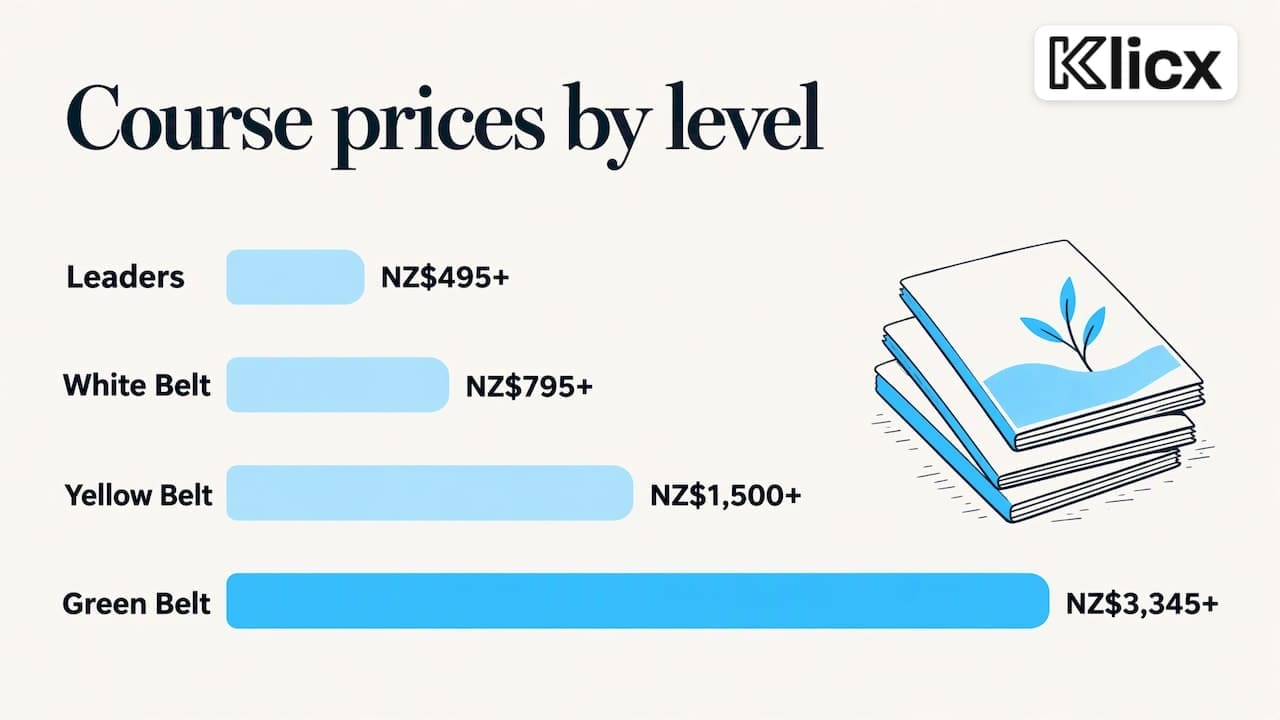
- Our Lean Six Sigma courses start from NZ$495 for leaders and NZ$795 for a White Belt, with Yellow and Green Belts above that.
Table of Contents
- What root cause analysis training actually teaches
- The techniques your team should leave with
- What an RCA qualification looks like in New Zealand
- How to choose a root cause analysis course for your team
- Where RCA fits in Lean Six Sigma
- Why training alone rarely fixes the problem
- How to measure whether RCA training worked
- Why large organisations invest in formal RCA
- Our approach
- Getting started with your team
- FAQ
- Sources
What root cause analysis training actually teaches
A root cause is the underlying system issue that allowed a problem to happen. New Zealand’s Health Quality and Safety Commission describes it as the issue behind the causal factor, and says understanding it matters because it leads to action plans more likely to prevent the event recurring.
The habit it replaces is familiar to every manager: a late shipment, a rework spike or a customer complaint gets a quick patch, and the same issue returns three months later. The Civil Aviation Authority’s guidance makes the same point for its own sector: root causes are often not obvious and tend to sit in processes, procedures, methodology or structure, so records, reports and evidence need careful analysis before anyone plans corrective action.
A well-built course, whatever the industry, should leave delegates able to do five things. The UK Ministry of Defence’s own RCA course outline is a useful benchmark: on completion delegates can develop problem statements, select the correct tool and present corrective action plans. In practice that breaks down like this:
- Write a precise problem statement. “Quality is poor” is not one. “Eleven per cent of orders in October shipped with the wrong label” is.
- Separate the root cause from contributing factors. Several things may have gone wrong. Only some are the reason it could happen at all.
- Choose a tool that fits the problem. A simple fault may need the 5 Whys. A messy, multi-factor one needs a fishbone diagram or data analysis.
- Gather evidence. Causes are tested against data, not argued by the loudest voice in the room.
- Plan and follow up on corrective action. The work ends with a measured result, not a workshop.
The techniques your team should leave with
People searching for RCA often ask for “seven techniques” or “five steps”. The number matters less than whether the team can apply a small set of tools well. Three do most of the work in ordinary business settings.
The 5 Whys
You ask “why?” repeatedly, each answer becoming the next question, until you reach a cause you can act on. The Health Quality and Safety Commission pairs the 5 Whys with a cause-and-effect diagram and insists that both are supported by data. Without data, the 5 Whys is just a tidy way of agreeing with your first guess.
The fishbone (cause and effect) diagram
A fishbone diagram, also called a cause-and-effect or Ishikawa diagram, puts the problem at the fish’s head and groups possible causes along the bones. It was devised by Japanese quality statistician Dr Kaoru Ishikawa for industrial use, and the Healthcare Quality Improvement Partnership sets out four stages: state the problem as the head, choose broad cause categories, review each category exhaustively, then analyse the finished diagram.
The categories you pick shape what the team sees. A US federal guide suggests starting with equipment and supplies, environment, rules and procedures, and people, and using multi-voting (each member marks their top three likely root causes) to narrow a crowded diagram. In manufacturing the familiar headings are machine, method, material, measurement, manpower and environment. In a services business, process, policy, systems and handovers often do more work.
A New Zealand health-sector guide notes the fishbone is most effective with a group, using a whiteboard or flipchart and coloured pens or sticky notes, brainstorming every possible cause before drilling down. That last point is where teams go wrong. They stop brainstorming when the first plausible cause appears, and the diagram becomes decoration.
Pareto analysis
Once you have a list of causes, a Pareto chart ranks them by how much of the problem each one produces, so the team fixes the few causes that account for most of the impact. Six Sigma-based RCA courses typically teach it as the step between brainstorming and action, and it is the step that stops a team spending a quarter on a cause that produces two per cent of the defects.
What an RCA qualification looks like in New Zealand
If you are wondering what an “RCA qualification” means here, NZQA gives a concrete answer. Unit standard 21515, Undertake root cause analysis in an organisation using operational excellence practices, is a Level 3, 5-credit standard. It credits people who can recognise problems, implement quick fixes, determine the root cause and develop permanent solutions.
Two related standards show how the topic sits inside wider quality skills:
- Unit standard 8087 covers using tools to manage quality in business. It spans four categories (idea generation, problem solving, decision making, and data collection and presentation) and requires competence in at least six tools, including one from each category.
- Unit standard 29280 applies to manufacturing data. It requires at least two root cause analysis techniques to determine causes of non-conformance, and measurement of outcomes against the improvement expected.
You do not need a delegate to complete a unit standard to benefit from RCA training. But these documents are a helpful yardstick: a credible course should have people applying at least two techniques to real data, and checking the outcome against an expected improvement. A course that only explains the theory of the fishbone falls short of that bar.
How to choose a root cause analysis course for your team
Course brochures look alike. These are the questions that separate them.
Does the course use your problems? The strongest learning happens when delegates bring a live issue from their own area. Ask whether the course expects a project, and whether someone coaches it through to a result.
Does it teach tool selection, not just tools? Knowing five tools is less useful than knowing which one suits a two-hour outage versus a chronic quality drift.
Does it include measurement? RCA without baseline and follow-up data cannot show that anything improved. Look for process measures, outcome measures and a clear method for checking the fix.
Where does RCA sit in the wider method? A stand-alone one-day course can be fine for a defined need. If your aim is a team that keeps improving, RCA should be part of a structured approach such as Lean Six Sigma, where problem definition, data and control of the improved process are all taught together.
Who needs it? Frontline staff, team leaders and sponsors need different depth. Executives rarely need to run a fishbone, but they do need to ask sharp questions and clear obstacles. That mix is why we separate our courses by role.
Is it delivered with a New Zealand lens? Regulations, workforce size and supply chains here differ from the examples in many imported courses. Local context makes the exercises easier to transfer.

Where RCA fits in Lean Six Sigma
In Lean Six Sigma, root cause analysis is not a separate subject. It is the core of the Analyse phase in the DMAIC cycle (define, measure, analyse, improve, control). Delegates define the problem, measure the current state, find root causes, test solutions and put controls in place so the gain holds.
That is the reason we teach it through staff capability programmes. Our courses are designed to give teams the confidence and skills for continuous improvement, and they come in levels so each role gets the right depth:
| Course | Who it suits | Price |
|---|---|---|
| Lean for Leaders: Sponsors and Champions | Executives and managers sponsoring improvement | from NZ$495 |
| Certified Lean White Belt Optimisation Foundation | Staff new to improvement thinking | from NZ$795 |
| Certified Lean Six Sigma Yellow Belt | Team members supporting improvement projects | from NZ$1,500 |
| Certified Lean Six Sigma Green Belt | Practitioners leading projects | from NZ$3,345 |
Prices are per person, one-off, as published on our site. The full list, including the EFQM courses, is on our courses page.
If your problems are less about a single process and more about the whole organisation, the EFQM model gives a structured way to assess where performance is weak across strategy, people, processes and results. That tells you where root cause work will pay off most.
Why training alone rarely fixes the problem
A delegate returns from a course with a fresh toolkit and an inbox of 200 emails. Within a month the toolkit is back in the folder. Three things bring it to life.
A sponsor who asks for results. When a manager expects a problem statement, evidence and a follow-up measure, people use the method. When nobody asks, they do not.
A real project in the first weeks. Pick a recurring problem with a visible cost: rework, complaints, delays. Our guides on process bottlenecks and improving service quality are good places to find candidates.
Support when the analysis gets difficult. Data is incomplete, the cause crosses two departments, or the evidence contradicts what the team believes. This is where practical implementation support makes the difference between a workshop and a result.
How to measure whether RCA training worked
You need two sets of numbers: whether the problem went away, and whether people did what the analysis said they would.
The Health Quality and Safety Commission separates the two. Outcome measures show the result you care about, such as falls per 1000 occupied bed-days. Process measures show whether the right steps were followed, such as the share of residents with a pressure injury risk assessment (45 of 50 is 90%). The toolkit says both types are needed, and that you should establish a baseline before the improvement project begins.
Translated to a business setting:
| What you track | Example | Why it matters |
|---|---|---|
| Outcome measure | Order errors per 1,000 shipped | Shows the problem shrinking |
| Process measure | Percentage of orders passing the new check | Shows the fix is being followed |
| Baseline | Error rate for the three months before the project | Gives you something to compare against |
| Recurrence | Same defect type reappearing within six months | Shows whether the root cause was truly removed |
New Zealand’s CAA says organisations should develop, measure and monitor their own quality indicators, and that internal procedures should monitor each corrective action to verify it was implemented on time, was effective and has a lasting impact. Its examples include incident-log analysis, root cause analysis from corrective and preventive action records, and customer complaints or surveys. Those translate neatly to most sectors.
A practical rhythm: record the baseline before work starts, review the process measure monthly while the fix beds in, and review the outcome measure at three and six months. If the outcome improves but the process measure slips, the gain is fragile.
The same logic applies to the training itself. Track the number of projects started, the number closed with a measured result, and the cost of the problem before and after. That gives you a fair answer when someone asks what the training delivered. Our piece on performance improvement consulting goes further on setting targets.
Why large organisations invest in formal RCA
The discipline is not limited to factories and clinics. PwC New Zealand’s 2024 Audit Transparency Report describes a root cause process run by an objective team of specialists. They review engagement information, interviews and working papers to find factors that contributed to audit quality, from supervision and professional scepticism to resources and training, and they compare audits with and without deficiencies to drive improvement.
The lesson for a mid-sized New Zealand business is that comparison and evidence beat opinion. You do not need a specialist team, but you do need people trained to look at what differs between the jobs that went well and the ones that did not.
Our approach
At Klicx we see root cause analysis as one link in a longer chain. An organisation needs to know where it stands, build the skills to act, and get help putting the changes in place. That is why we combine EFQM assessment, capability building and practical implementation, with a New Zealand perspective.
Training is where the capability starts. A team trained in Lean Six Sigma methods gains a shared language for defining problems, measuring them and fixing them, which makes improvement a routine rather than a rescue. Where the issues are bigger than one process, an assessment shows where to look first, and our consulting and digital solutions work helps carry the changes through.
If you are choosing between sending one person on a course and building a team habit, we would build the habit. Put sponsors, practitioners and the people doing the work through the right level of training, give them a real problem, and measure the result.
Jeremy
Getting started with your team
A sensible first step is to match roles to courses: leaders on Lean for Leaders from NZ$495, team members on a White or Yellow Belt, and project leads on a Green Belt from NZ$3,345. If your question is bigger than one process, our business assessment shows where performance is held back, and our business improvement service helps you act on what it finds.

Browse the programmes and current course details on our courses page, or talk to us through klicx.co.nz about the right mix for your organisation.
FAQ
What is root cause analysis in quality assurance?
It is a structured way of finding the underlying system issue behind a defect or incident, so the corrective action targets the cause and not just the symptom. In quality assurance it feeds the corrective and preventive action process: analyse first, plan the fix second, then monitor that the fix lasts.
How does a fishbone diagram show cause and effect?
The problem sits at the head of the fish, and the bones are broad categories of possible cause, such as people, process, equipment and environment. The team adds specific causes under each bone, then uses data and voting to decide which are likely root causes. It works best as a group exercise, so each category is examined fully.
What are the main steps of root cause analysis?
Define the problem precisely, assemble the right team, contain the immediate impact, gather evidence, identify and test causes with a tool such as the 5 Whys or a fishbone diagram, plan corrective action, and then measure whether the problem stays solved. The last step is the one most often skipped.
How do I measure process improvement after an RCA?
Set a baseline before you start, then track an outcome measure (the result you care about) and a process measure (whether the new steps are followed). Review both at regular intervals, and watch for the same defect returning. If the outcome improves while the process measure falls, the fix is unlikely to last.
Sources
- Root cause analysis course (RCA), GOV.UK
- Advisory Circular 000-3, Civil Aviation Authority of New Zealand
- Unit standard 21515, NZQA
- Unit standard 8087, NZQA
- Unit standard 29280, NZQA
- Quality improvement tools: Fishbone diagrams, Wharaurau
- How to Use the Fishbone Tool for Root Cause Analysis, CMS
- Using root cause analysis techniques in clinical audit, HQIP
- Quality improvement toolkit, Health Quality and Safety Commission
- Audit Transparency Report 2024, PwC New Zealand
Recommended
- How to Improve Service Quality in a NZ Organisation
- Process Bottlenecks: How to Find and Fix Them in Your Business
- Reducing Operational Costs: A Practical Plan for NZ Organisations
- Operational Efficiency Improvement: A Practical Guide for NZ Organisations
This article was produced with AI assistance and reviewed for accuracy. It is provided for general information only and is not professional advice.