Digital transformation consulting helps an organisation decide which processes, systems and skills to change, and in what order, so that technology improves results instead of adding cost. The best engagements start with the performance problem, not the software. At Klicx we work this way: we assess where the organisation stands, build the capability of the people who will run the change, and support the digital solutions that follow.
TL;DR
- Digital transformation consulting is strategy, process redesign, technology selection and change support, in that order of importance.
- Transformations most often fail on people and unclear problems, not on the technology itself.
- A sound roadmap begins with an honest assessment, then standardises processes, then sets governance, then deploys systems.
- Costs in NZ are set by scope, the number of people affected and how much capability your own team needs to build, so expect a quote tied to scope rather than a flat rate.
- Pick a consultant who covers assessment, training and implementation, so the work does not stall after the report.
Table of Contents
- What digital transformation consulting actually is
- Who should lead the work inside your organisation
- What a consulting engagement typically includes
- Why transformations fall short
- Setting priorities and building a roadmap
- What results look like and how to measure them
- How engagements are structured and what drives cost
- Building capability inside your team
- Choosing a digital transformation consultant
- Our perspective
- Where to start with Klicx
- FAQ
- Sources
What digital transformation consulting actually is
A digital transformation consultant helps an organisation use technology to change how it operates, serves customers and competes. That sounds broad because the work is broad. In practice it sits across four layers:
- Direction: what the organisation is trying to achieve, and which problems are worth solving first.
- Process: how work flows today, where it stalls, and what a better flow looks like.
- Technology: which systems, integrations and automation support that flow.
- People: whether staff have the skills, confidence and ownership to use the change.
Most disappointing projects skip the first two layers and buy technology to fix a problem nobody has defined. The consultant’s value is in making the earlier layers explicit before money is committed to the later ones.
For a New Zealand manager, this also has a local dimension. Many NZ organisations are small or mid-sized, with lean teams, limited internal IT and little spare capacity. A programme designed for a global enterprise with a dedicated transformation office will not fit. The work has to be sized to the people who will carry it.
Who should lead the work inside your organisation
A consultant advises. Your organisation still owns the result. The Institute of Directors (NZ) describes the board’s role in digital transformation as setting strategy and monitoring organisational performance, with processes and policies that give accountability to stakeholders. That tells you where leadership sits: strategy and accountability belong to the board and executives, and day-to-day delivery belongs to a named sponsor with the authority to change how work is done.
A workable split looks like this:
- Executive sponsor: owns the business case and removes obstacles.
- Process owners: the managers who run the work being changed. They decide what “better” means.
- Project lead: keeps scope, timeline and risks visible.
- Consultant: brings method, an outside view and capability building.
When the sponsor role is vacant, projects drift. When process owners are not involved, the new system is built around how the project team imagines the work, not how it happens. This is why we train sponsors and champions as well as practitioners. Our Lean for Leaders course, for sponsors and champions, is from $495 (NZD).
What a consulting engagement typically includes
Names differ between firms, but sound engagements pass through the same stages.

1. Assessment
You establish where the organisation is now: strategy clarity, leadership, process performance, customer and people results, and the state of current systems. A structured framework matters here because it stops the assessment becoming a collection of opinions. We use the EFQM framework for this, which gives a consistent way to look at direction, execution and results. You can see how that works on our business assessment page.
2. Priorities and roadmap
Assessment findings are turned into a short list of changes, ranked by value and effort. A good roadmap is specific: which processes change first, who owns each, which systems are touched, what is measured and when it is reviewed. A roadmap with twelve initiatives and no owners is a wish list.
3. Process improvement
Before automating, you simplify. Lean and Six Sigma methods remove waste and variation, so what you digitise is a clean process rather than a tangle of workarounds. Our business improvement work covers this stage.
4. Digital solution design and deployment
This covers workflow tools, system integration, data flows and automation. Our digital solutions service sits here, and our guides on digital workflow solutions and data integration services explain how to scope each.
5. Capability building and handover
The change only lasts if your own people can run and improve it. Training in methods such as Lean Six Sigma and EFQM turns a one-off project into a continuing habit.
Why transformations fall short
The research is consistent that failure is common. A 2024 bibliometric analysis in the Journal of Business Research found that failure rates remain high, and that much of the literature frames digital transformation in terms of technology, information systems and management without examining the specific features that cause failure.
Four patterns show up repeatedly:
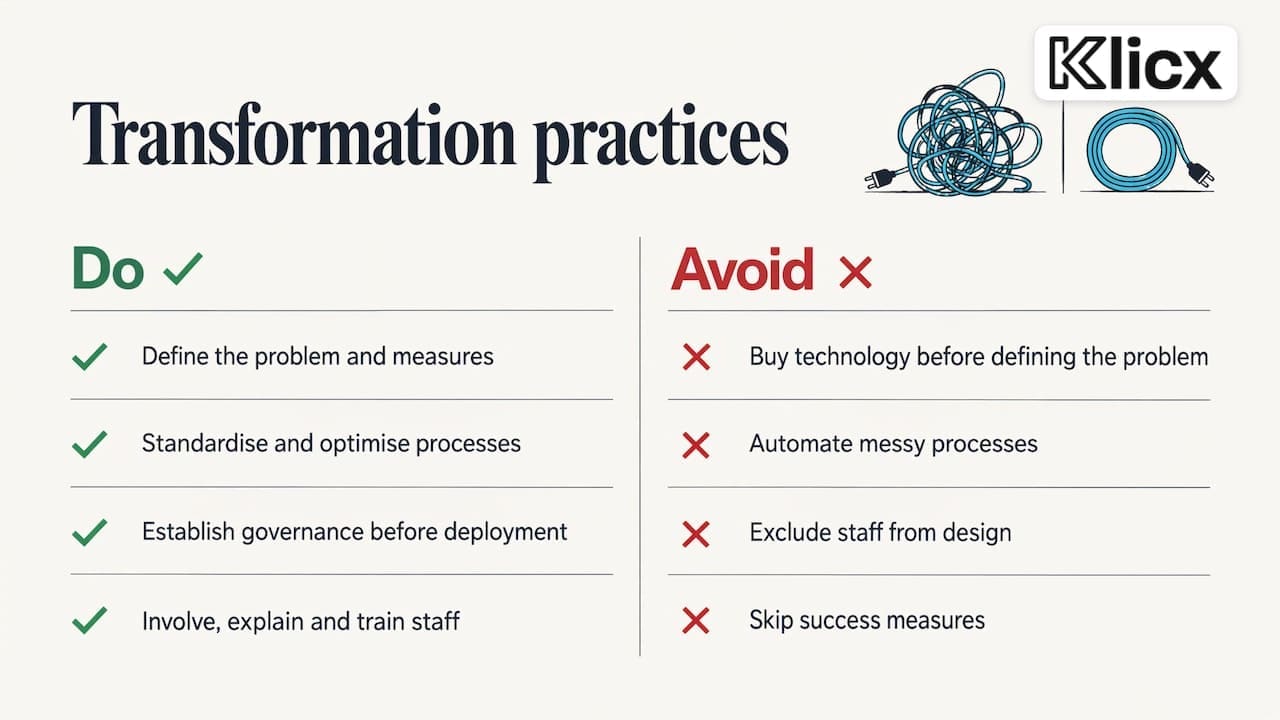
Technology first, problem second. A system is bought because it is available or because a competitor has one. Nobody can say which measure it should improve.
Automating a messy process. One framework summary describes the disciplined order as defining the problem, standardising and optimising processes, establishing governance, then deploying technology, which avoids the trap of automating chaos. The same logic underlies Lean: fix the flow, then speed it up.
Underestimating people. Staff who were not involved in the design have little reason to use the result. The same source reports that nearly two-thirds of employees resist organisational change to some degree. Resistance is normal, and it is managed through involvement, clear explanation and training, not through announcements.
No measures. If you cannot say at the start what “better” looks like, you cannot show it at the end.
Setting priorities and building a roadmap
Here is a practical sequence your leadership team can follow, with or without a consultant in the room.
- Write the problem in one sentence. For example: “Quotes take nine days to reach customers, and we lose work to faster competitors.” If you cannot, you are not ready to choose technology.
- Map the current process end to end. Walk it with the people who do it. Note handoffs, re-keying, waiting and rework.
- Choose two or three measures. Cycle time, error rate, cost per transaction, customer response time, staff hours. Record the baseline now.
- Rank candidate changes by value and effort. Start with changes that are valuable and achievable within a quarter, so the organisation sees progress.
- Name an owner for each change. One person, not a committee.
- Simplify, then digitise. Remove steps that add no value before any tool touches them.
- Set governance. Decide who reviews progress, how often and what triggers a change in plan.
- Deploy in stages and train as you go. Pilot with one team, learn, then extend.
This is where an outside facilitator earns their fee. Teams close to the work often struggle to challenge their own habits, and a structured assessment gives everyone the same picture to argue from.
What results look like and how to measure them
Results should be stated in the organisation’s own measures. The Auckland-based Griffin’s Food Company, for instance, reports gains from scaling an IoT platform to three full production lines, including better asset utilisation, less waste, higher quality and a paperless shop floor. That is a supplier’s case study, so treat it as an illustration of the kinds of measure that matter, not as a forecast for your site.
Typical measures to track:
| Area | Example measure | Why it matters |
|---|---|---|
| Speed | Process cycle time, response time | Shows whether flow improved |
| Quality | Error and rework rate | Shows whether the process is stable |
| Cost | Cost per transaction, staff hours per task | Links the change to the budget |
| People | Adoption rates, staff confidence | Shows whether the change is sticking |
| Customer | Resolution time, satisfaction | Shows the outside effect |
Field-based teams are a good example of where digitised workflow pays off. Tools that capture orders or records at the point of work, such as no-code workflow automation that connects platforms without engineering involvement, reduce double handling. The principle is the same in any sector: capture data once, where the work happens.
How engagements are structured and what drives cost
Published price lists for transformation consulting are rare, because the scope differs so much between organisations. We do not publish a price for our consulting, assessment or digital solution work, which is scoped per project. Our training courses do have published prices. What changes the cost of any engagement:
- Scope: one process or the whole organisation.
- Number of people and sites affected.
- Starting maturity: how clear your strategy and processes are already.
- Integration complexity: how many existing systems must connect.
- Capability you want to leave behind: more training means a more self-sufficient team afterwards.
- Support after go-live: how much help you want through the first months.
A useful way to compare proposals is to ask what you will own at the end. A report is one thing. Trained staff, working processes and a live solution are another.
Engagements usually take one of three shapes: a short assessment that produces a roadmap, a defined improvement or implementation project, or an ongoing programme that combines projects with training. Many organisations begin with the assessment, because it makes every later decision cheaper and better informed.
Building capability inside your team
The organisations that keep improving have people who know how. Training is how that happens, and it is the part most often left out of a technology-led proposal. Our published course prices, from the courses page:
| Course | Price |
|---|---|
| Lean White Belt Optimisation Foundation | from $795 (NZD) |
| Lean Six Sigma Yellow Belt | from $1,500 (NZD) |
| Lean Six Sigma Green Belt | from $3,345 (NZD) |
| EFQM Foundation, Fast Track | from $795 (NZD) |
| EFQM Foundation, In-Depth | from $1,500 (NZD) |
| EFQM Assessor Course (4 Day) | from $3,345 (NZD) |
| EFQM Fast Track Foundation + Assessor, online (5 days over 3 weeks) | from $3,975 (NZD) |
| EFQM Fast Track Foundation + Assessor, face to face (5 days) | from $4,195 (NZD) |
A sensible pattern is to train leaders first so they sponsor change well, then equip process owners with Lean Six Sigma so they can find and fix waste, and use the EFQM courses for those who will lead or support assessments.
Choosing a digital transformation consultant
Ask these questions of any firm, including us:
- Do you start from the problem or from a product? The first answer should be about your performance.
- How will results be measured? Look for baselines and named measures.
- Who does the work on our side? The best proposals state what is needed from your people.
- What happens to our staff’s skills? Look for training and handover.
- Do you understand NZ conditions? Smaller teams, regional spread and local regulation shape what is practical.
- Can the same firm carry the work from assessment to implementation? Handoffs between separate firms are where intent leaks away.
Our perspective
We have seen the same pattern across New Zealand organisations: leaders want results, buy technology, and then discover the real obstacle was unclear direction or a process nobody had examined. So we begin with assessment.
The EFQM framework gives us a consistent way to look at strategy, leadership, processes and results together. From there we build the capability of your people through Lean Six Sigma and EFQM training, and we support the practical implementation, including digital solutions that fit the improved process.
We think that combination is what makes change last. Assessment tells you where to act, training gives your team the skills to act, and implementation support turns the plan into something running in the business. Delivered with a New Zealand perspective, it supports the whole improvement journey rather than one piece of it.
Jeremy
Where to start with Klicx
If you are weighing up a transformation, the most useful first step is a clear picture of where your organisation stands. Our business assessment gives you that picture, and our team can then scope improvement, digital solutions and training around it. If you want to build internal skills at the same time, the course range starts from $430 (NZD) for the EFQM Model / Methodology Appreciation course.

To discuss your situation, start from the Klicx home page or read more on our Insights pages, including our guide to operational efficiency improvement.
FAQ
What does a digital transformation consultant do?
A consultant assesses how your organisation works, helps you decide which changes matter most, and supports the redesign of processes and the deployment of systems. They also help your people build the skills to run the change. The strongest engagements leave your team more capable than before.
How long does a digital transformation take?
It depends on scope. A focused improvement to one process can show results within a few months, while organisation-wide change is a multi-year programme delivered in stages. Staging the work lets you check results and adjust the plan as you go.
How much does digital transformation consulting cost in New Zealand?
There is no standard rate, because cost follows scope, the number of people affected, system integration and how much training is included. Most firms quote per project after a conversation or an assessment. Training courses, by contrast, have per-person published prices.
Who should lead digital transformation?
Strategy and accountability sit with the board and executives, as the Institute of Directors guidance sets out. Delivery needs a named sponsor and process owners close to the work. A consultant supports them with method and capability building.
Sources
- Institute of Directors (NZ): Digital Transformation Quick Guide, June 2022
- Why do so many digital transformations fail? A bibliometric analysis, Journal of Business Research, 2024
- Why digital transformation fails: 5 root causes, 2025
Recommended
- Digital Workflow Solutions: A Practical Guide for NZ Organisations
- Data Integration Services in NZ: What to Buy and How to Scope It
- Organisational Effectiveness Consulting: What It Is and How to Choose
- Operational Efficiency Improvement: A Practical Guide for NZ Organisations
This article was produced with AI assistance and reviewed for accuracy. It is provided for general information only and is not professional advice.