Performance improvement consulting is outside help to find out why an organisation is not performing as well as it should, fix the causes, and leave your people able to keep improving. The best engagements do three things together: they assess where you really are, build the skills of your own staff, and stay for the implementation. A report that sits in a drawer is not an improvement. At Klicx, we combine EFQM assessment, capability building and practical implementation support for New Zealand organisations, so the plan, the training and the delivery come from one place.
This guide is for owners, executives and managers who are weighing up a consultant. It explains what the work involves, what problems it suits, how an engagement runs, what it costs to build capability, and how to tell afterwards whether it worked.
TL;DR
- Performance improvement consulting starts by diagnosing the cause of a performance gap, then designs, delivers and measures the fix. It is not a menu of solutions picked in advance.
- The work that lasts combines three things: a clear strategy, better processes, and staff who can run improvement themselves.
- A good engagement separates deliverables (a report, a roadmap) from outcomes (faster cycle time, lower unit cost, better retention) and sets a baseline for each outcome.
- Training your own people in Lean Six Sigma or EFQM is what keeps gains in place after the consultants leave. Klicx courses start from NZ$495 per person.
- Ask any consultant who owns each outcome, how it will be measured, and what your team will be able to do alone at the end.
Table of Contents
- What performance improvement consulting means
- Problems that performance improvement consultants address
- How a consulting engagement assesses your organisation
- Three levers that improve performance
- Where digital solutions fit
- An example of performance improvement in practice
- Measuring whether it worked
- How to choose a performance improvement consultant
- Building your team’s capability
- Working with Klicx
- Our perspective
- FAQ
- Sources
What performance improvement consulting means
The phrase covers a wide field, and some of the pages you will find searching it are about HR performance plans for individual employees or about learning and development teams. This article is about the organisational kind: improving how a business, team or department performs against its goals.
The core idea is simple. You have a gap between the results you want and the results you get. A performance consultant works out why the gap exists before proposing anything. New Zealand’s HR professional body, HRNZ, describes performance consulting as starting from the premise that there is a performance problem whose cause is not yet known. The consultant works with you to explore it, propose and deliver solutions, and measure success. HRNZ also notes that this data-driven approach is less prone to scope creep, because the work is anchored to the problem rather than to a list of tasks someone ordered.
That last point separates a consultant from a contractor. A contractor does what the brief says. A performance consultant challenges the brief when the evidence points elsewhere.
Problems that performance improvement consultants address
Organisations usually call in help when one of a handful of symptoms will not go away:
- Unclear strategy. Leaders agree on a direction but teams cannot say what it means for their week. Goals compete, and nobody can tell which project matters most.
- Inefficient processes. Work is handed over three times, rework is routine, approvals queue up, and customers wait.
- Skills gaps. People are asked to improve things without a shared method, so each team invents its own and nothing connects.
- Disconnected systems. Data is retyped between tools, reports disagree, and staff spend time on administration that a workflow could handle.
- Projects that stall. Initiatives start well, lose ownership, and fade without a measure of whether they worked.
These are the problems our own work is built around. The common thread is that the visible symptom (late delivery, rising costs, staff frustration) is rarely the cause. That is why diagnosis comes first.
How a consulting engagement assesses your organisation
HRNZ sets out an eight-step method for performance consulting. Reduced to its essentials, an engagement should look like this:
- Explore the problem with open questions. The consultant asks what is happening, what should be happening, and what the difference costs, without assuming a solution.
- Compare ideal and current performance. Interviews, document review, surveys, observation and data show where the gap sits. HRNZ lists these as the standard evidence sources in its eight-step method.
- Investigate causes. Tools such as the “five whys” push past symptoms. If deliveries are late, why? Because orders are entered late. Why? And so on until a cause you can fix appears.
- Report findings to stakeholders and agree the solutions together, so the people who must change have helped choose the change.
- Plan how success will be measured before anything is designed or delivered.
- Design and deliver the solutions, which might be process redesign, training, a digital workflow, or a mix.
Notice that measurement is planned before delivery. If a consultant proposes to decide the measures later, the engagement has no fixed point to be judged against.
Using a framework for the assessment
An assessment is stronger when it uses a recognised yardstick instead of one adviser’s opinion. The EFQM Model is one such framework. Its 2025 edition scores organisations out of 1000 points across seven criteria, and its results criterion looks for results that are timely, reliable and accurate, with positive trends sustained over time and ambitious external comparisons.
This is the approach we take. Klicx uses the EFQM framework to assess an organisation, then builds capability and supports implementation, so the assessment leads straight into action. You can see how this works on our business assessment page, and on our EFQM page for assessment support.
Three levers that improve performance
Most lasting improvement draws on three connected levers. Pulling only one is the usual reason gains fade.
Strategy that people can act on
Business.govt.nz, the New Zealand government’s business guidance site, says a strategy statement and a scorecard are the two key documents for tracking strategy. It suggests breaking objectives into four categories: finances, customers and stakeholders, internal processes, and innovation and learning. Its change process starts with shared values, makes sure everyone understands the change, and ends with getting the change to stick. It also advises trying changes out in stages, and notes that improvement sticks when key people show how new approaches have raised performance.
For an executive, the practical test is whether a team leader can point to the scorecard line their work affects.
Processes that waste less
The same government site explains that efficiency gains come from reducing costs (the same output from less input), increasing output (more from the same input), or growing the business (much more output for a little more input). It distinguishes improving operational efficiency, which means doing the same thing better in incremental steps, from process innovation, which reaches the same result in a completely new way.
Most organisations need the first before the second. Removing handovers, rework and waiting time is usually faster and cheaper than reinventing a process. Our guide to operational efficiency improvement goes through this in more detail for New Zealand organisations.
Staff who can keep improving
Spark NZ and Icehouse’s 2026 productivity pack reports that staff development and skills recruitment ranked first as an efficiency investment for 58% of smaller organisations and 42% of businesses with 50 to 99 employees. New Zealand businesses are telling surveyors what experience teaches: skills carry improvement.
CEDA’s people strategy toolkit makes a related point. Workforce development should link back to business strategy, and staff should be viewed as an investment rather than a cost.
This is where training matters. A team that has been through a shared method, such as Lean Six Sigma, can map a process, find the waste and measure the result without waiting for an outside expert. We train staff in these methods so that the confidence and skills stay in your organisation.
Where digital solutions fit
Sometimes the cause of a performance gap is that people are doing by hand what a system should do. Re-keying data between tools, chasing approvals by email and building reports in spreadsheets all consume hours that add no value.
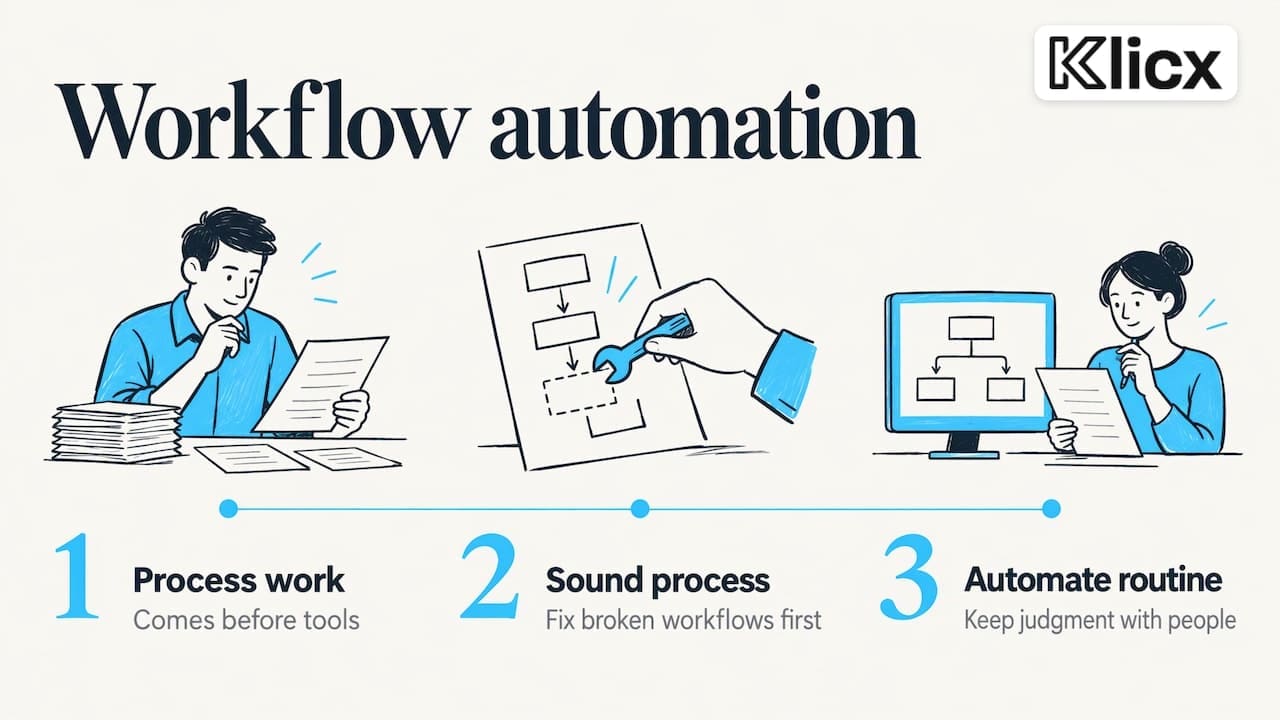
The fix is a workflow or integration project, and it should follow the process work, not replace it. Automating a broken process only makes the broken process faster. Once the process is sound, tools can carry the repetitive steps. Insurance teams, for example, now use insurance workflow automation to handle policy checking, form preparation and certificate requests, with human review kept for decisions. The same logic applies in any sector: automate the routine, keep people on the judgement calls.
We cover the practical side of this in our guides to digital workflow solutions and data integration services in NZ.
An example of performance improvement in practice
A New Zealand case shows what measurable improvement looks like. At Carter Holt Harvey’s Kinleith mill, a five-year shared-risk, shared-reward maintenance performance contract began in December 2002, with bonus and penalty clauses tied to jointly defined KPIs. According to the trade press report, productivity per employee rose 36% over two years, production volumes rose about 8%, maintenance costs fell 15% in the first year, and 14 production records were set between June 2003 and March 2004.
The lesson is not the size of the mill. It is the design: the targets were agreed jointly, the measures were defined up front, and both sides had a stake in the result. Those are the features to look for in any engagement, large or small.
Measuring whether it worked
Many engagements end with a good report and no proof of change. Plan the measurement at the start.
The New Zealand Boutique Consultancy Association draws a useful line between a deliverable (a report, a roadmap, a training plan) and an outcome, a measurable change that matters, such as improved customer retention, faster cycle time or lower unit cost. Its guidance on measuring consulting outcomes recommends:
- A balanced scorecard with four lenses: financial, customer, internal process, and learning and growth, using both leading and lagging indicators.
- SMART objectives with acceptance criteria.
- A plan-do-study-act loop, so results feed the next round of improvement.
- An owner, a baseline and a measurement method for every outcome.
- Where feasible, at least two independent data sources, and a counter-metric alongside any measure that could be gamed.
A simple worked example: a services firm wants faster quote turnaround. The outcome is days from request to quote. The baseline is the current median from the last six months of records. The owner is the sales operations manager. The target is agreed before any change. A counter-metric, such as quote acceptance rate, ensures speed has not been bought by sloppiness. Three months later, the same data source shows whether it worked.
The EFQM approach adds a longer view: results should show positive trends sustained over time, not a single good quarter.
How to choose a performance improvement consultant
A few questions separate substance from polish:
- Do they diagnose before they prescribe? Ask how they will find the cause of your problem and what evidence they will gather.
- Do they work to professional standards? The Institute of Management Consultants NZ’s guide for aspiring Certified Management Consultants sets expectations including clear client reports and a process that enables client learning and performance improvement.
- Will your people learn the method? If the answer is no, you will need to buy the same help again.
- Is the scope tied to outcomes? Each outcome needs an owner, a baseline and a measure.
- Can they carry the work through to implementation? Assessment, training and delivery from one team removes the handover gaps where plans lose momentum.
For a wider look at how to compare providers, see our guide to organisational effectiveness consulting.
Building your team’s capability
Training is the part of improvement that compounds. Our course range for New Zealand organisations runs from awareness to certification:
| Course | Who it suits | Price (per person) |
|---|---|---|
| Lean for Leaders, Sponsors and Champions | Executives and managers who sponsor improvement | from NZ$495 |
| Lean White Belt Optimisation Foundation | Staff new to improvement methods | from NZ$795 |
| Lean Six Sigma Yellow Belt | Team members supporting improvement projects | from NZ$1500 |
| Lean Six Sigma Green Belt | People who lead improvement projects | from NZ$3345 |
| EFQM Model / Methodology Appreciation | Leaders wanting an overview of the model | from NZ$430 |
| EFQM Foundation, Fast Track | Teams starting with EFQM | from NZ$795 |
| EFQM Foundation, In-Depth | Teams needing a deeper grounding | from NZ$1500 |
| EFQM Assessor Course (4 Day) | People who will assess against the model | from NZ$3345 |
| EFQM Fast Track Foundation + Assessor, online (5 days over 3 weeks) | Busy teams preferring online | from NZ$3975 |
| EFQM Fast Track Foundation + Assessor, face-to-face (5 days) | Teams preferring in-person intensives | from NZ$4195 |
A sensible pattern is to train sponsors first, so leaders can back the work and ask the right questions, then train the people who will run projects. Improvement efforts often stall because the leaders who must clear obstacles never learned what the team is doing.
Working with Klicx
If you want a partner for the whole journey, our business improvement work covers assessment, capability building and implementation support, with innovation and project management and digital solutions available where the diagnosis calls for them. We work with organisations from small businesses to larger corporates, with a New Zealand perspective.
Start with our business improvement page to see how we work, or browse the courses if building your team’s skills is the first step.

You can also see the full range on our what we do page, or start at klicx.co.nz.
Our perspective
Most performance problems we see described to us are really three problems wearing one coat: a strategy people cannot translate into daily work, processes that carry waste nobody has measured, and teams without a common method to fix either.
That is why we do not treat assessment, training and implementation as separate products. An assessment against the EFQM framework tells you where you stand. Training in Lean Six Sigma and EFQM gives your people the skills and confidence to act on it. Implementation support, including digital solutions where they belong, turns the plan into changed work.
The measure of a good engagement is what your team can do when we step back. If they can map a process, find the waste, set a baseline and show the result, the improvement has a chance of lasting. That is the outcome we design for.
Jeremy
FAQ
What does a performance improvement consultant do?
A performance improvement consultant works out why an organisation is not meeting its goals, then helps design, deliver and measure the fix. The work typically includes interviews, data analysis, cause investigation, recommendations and support putting changes in place. Strong consultants also build your team’s skills so the gains last.
How is performance improvement consulting different from general management consulting?
It is narrower and more evidence-led. It starts from a performance gap of unknown cause and works backwards from measured results, rather than starting from a preferred solution. General management consulting can cover any strategic question, including market entry or restructuring.
How long does it take to see results?
That depends on the problem. Quick wins such as removing a handover or a duplicated approval can show in weeks, while cultural and strategic change takes longer. Agree a baseline and review points at the start so progress is visible along the way.
Should we train our own staff or just hire a consultant?
Both work best together. A consultant brings an outside view and structure, while trained staff keep the improvement going after the engagement. Our courses start at NZ$495 per person for leaders and go up to certification-level programmes.
Sources
- HRNZ: Performance consulting
- The EFQM Model 2025
- Business.govt.nz: Turning strategy into action
- Business.govt.nz: Operational efficiency and innovation
- Spark NZ and Icehouse productivity pack 2026
- CEDA people strategy toolkit
- Massive Maintenance, Kinleith mill report
- NZBCA: Measuring Real Consulting Outcomes
- IMC NZ guide for aspiring Certified Management Consultants
- Policy IQ insurance workflow automation
Recommended
- Business Improvement
- Organisational Effectiveness Consulting: What It Is and How to Choose
- Operational Efficiency Improvement: A Practical Guide for NZ Organisations
- Business Assessment & Improvement Roadmap NZ
This article was produced with AI assistance and reviewed for accuracy. It is provided for general information only and is not professional advice.