
Organisational effectiveness consulting helps an organisation work out how well it achieves its goals, find what holds it back, and put changes in place that stick. A good consultant diagnoses before prescribing, measures a baseline, builds your people’s capability and stays with you through delivery. This guide explains what the work covers, how effectiveness is measured, what an engagement looks like, and what to weigh when you hire help in New Zealand.
TL;DR
- Organisational effectiveness is the degree to which an organisation achieves its goals, so any engagement starts by defining those goals and a baseline.
- Consultants diagnose through interviews, data and process analysis, then agree solutions, deliver them and measure the result.
- Structured frameworks such as EFQM give you a repeatable way to score direction, execution and results.
- Change lasts when your own people are trained to run it, through methods like Lean Six Sigma and clear project management.
- Choose a consultant who assesses, builds capability and supports implementation, not one who only hands over a report.
Table of Contents
- What organisational effectiveness actually means
- What an organisational effectiveness consultant does
- Signs your organisation could use outside help
- How effectiveness is measured
- What a consulting engagement looks like
- How to tell whether the changes worked
- Why training and project management decide whether change sticks
- Perspective: why assessment, training and delivery belong together
- What to consider when choosing a consultant in New Zealand
- How Klicx supports the whole improvement journey
- Ready to start?
- FAQ
- Sources
What organisational effectiveness actually means
The plainest definition is the one most practitioners use: organisational effectiveness is the degree to which an organisation achieves its goals, including output, efficiency, aligned internal processes and the resources needed to compete. It sounds simple, but the definition hides the hard part. Academic work on the topic notes that defining “effectiveness” is itself an issue, and that integrated models treat it as the interaction of several indicators: goals, internal processes and systems, and stakeholder perspectives.
In practice, that means an effective organisation is not just profitable. It has a strategy people understand, processes that do not waste effort, and staff who know how their work connects to the result. Traditional measures such as profitability, return on assets and equity, market share and sales growth still matter, but research increasingly argues that non-financial factors belong in the picture, particularly as sustainability becomes more important.
So when a manager says “we need to be more effective”, the first job is to ask: effective at what, for whom, and measured how?
What an organisational effectiveness consultant does
An organisational consultant is a specialist who helps a company improve how it is structured, managed and run. Their core work is to diagnose performance issues, analyse workflows and design solutions. According to a business school careers guide, they typically use interviews, data analysis and observation to uncover root causes of problems like low productivity, unclear roles or inefficient processes.
In plain terms, the work breaks into four activities:
- Diagnose. Talk to leaders and staff, look at the numbers, and map how work really flows, not how the process document says it flows.
- Prioritise. Separate the symptoms (missed deadlines, rework, low morale) from causes (unclear strategy, handoffs between teams, missing skills).
- Design and deliver. Agree solutions with you, then help put them in place: process redesign, training, new systems, project structures.
- Measure. Compare outcomes against the baseline so you can see whether the change worked.
Consultants usually specialise. The Institute of Management Consultants NZ notes that consultants commonly focus on areas such as strategic planning, process improvement or supply chain management, and some also concentrate on a particular industry. That is useful to know when you write a brief: a firm strong in process improvement is a different hire from one strong in executive coaching.
Signs your organisation could use outside help
You do not need a crisis. The common signals are quieter:
- Leaders describe the strategy differently from each other.
- The same problems return after every “fix”.
- Work stalls at the boundaries between teams.
- Projects overrun and nobody can say why.
- Improvement depends on one or two enthusiastic people rather than a shared method.
- You cannot easily show the board what changed after a major initiative.
If two or three of these sound familiar, a structured assessment will usually tell you more in a few weeks than another internal workshop.
How effectiveness is measured
Measurement is where many improvement efforts go soft. Three approaches are worth knowing.
Goal-based and balanced measures
The balanced scorecard, developed by Kaplan and Norton in 1992, recommends tracking a small number of key measures across four perspectives: financial, customer, internal business process, and staff learning and growth. Its value is balance. A business can hit its financial targets while quietly burning out its people or losing customers, and a single-lens measure will not show it.
Benchmarking
Benchmarking is the systematic comparison of your performance with high-performing peers. A New Zealand study from Massey University describes internal, competitive and functional benchmarking as the main types. Functional benchmarking, comparing a specific process with the best performer in any industry, is often the most revealing because it escapes the “we are better than our competitors” trap.
Structured excellence frameworks
The EFQM Model gives you a ready-made structure. The EFQM Assessment, used by more than 50,000 organisations globally, gives structured feedback across three dimensions:
| Dimension | What it examines |
|---|---|
| Direction | Alignment and shared understanding of the business, an external strategic view, and foundations that fit the future |
| Execution | Actionable insights to lift performance, accelerate change and keep people engaged and motivated |
| Results | Performance on return on investment, customer service, efficiency, people performance and stakeholder value |
EFQM also offers different depths. Its Rapid review combines a diagnostic workshop, leadership interviews and focus groups, needs no advance preparation and produces a score out of 100 within a week. The Advanced review assesses against the full model’s 29 criterion-parts with an on-site assessor team, produces a score out of 1,000 and runs over four to six months. Many organisations begin light and go deeper once leaders see the value.
Whatever you use, the rule from the research is the same: before you change anything, ask what goals you are trying to achieve, whether they are clearly communicated, and how often you will review progress.
What a consulting engagement looks like
Engagements differ, but good ones follow a recognisable arc. New Zealand’s HR institute describes a performance consulting process of eight steps: identify opportunities, find gaps and causes, agree solutions, plan success measures, design and deliver solutions, collect, analyse and report results, and close the project.
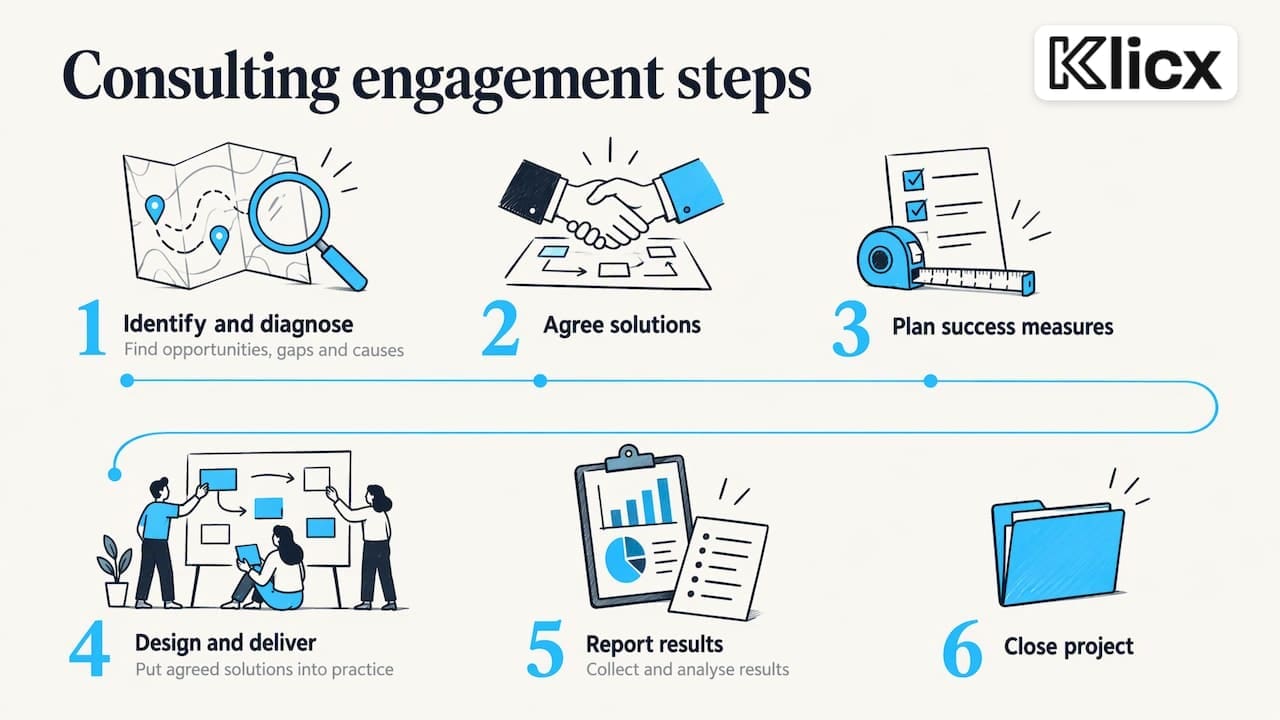
Here is how that translates into a typical timeline for an organisational effectiveness project.
1. Scope and baseline
You and the consultant agree the business problem, who is affected and what success looks like. This is also when the baseline gets measured, whether that is cycle time, error rates, an EFQM score, staff survey results or cost per transaction.
2. Assessment
Interviews, focus groups, data review and process mapping. Done well, the output is a short list of root causes ranked by impact, not a 120-page report that sits in a drawer.
3. Roadmap
The findings become a sequenced plan: what to fix first, who owns it, what it costs and how you will know it worked. Small quick wins early build momentum.
4. Capability building and implementation
This is the stage that separates lasting change from a consultant’s slide deck. Your people learn the methods, run the improvements, and the consultant supports them through the awkward middle.
5. Review and close
Measure the outcome against the baseline, report to stakeholders, and decide what continues as business as usual.
The same HR source notes that this kind of approach is data-driven and less prone to scope creep, which also makes it popular with leaders who like to see the numbers behind a project.
How to tell whether the changes worked
The advice from New Zealand HR practitioners is blunt: measure the baseline and the outcome. Large projects call for return on investment reporting, while smaller ones may be better judged on staff impact or new behaviours.
A practical way to apply it:
- Pick two or three measures before you start. One financial or output measure, one customer or quality measure, one people measure.
- Record the starting figure. Without it, any improvement is an anecdote.
- Set a review rhythm. Quarterly is common for ongoing improvement, with a formal review at project close.
- Reassess with the same method. If you used an EFQM Rapid review at the start, repeat it later so scores are comparable.
The Massey study also describes a seven-step self-assessment cycle: preparation, engagement, evaluation, analysis, action planning, implementation and review. The last step loops back to the first, which is the point. Effectiveness is a habit, not a project.
Why training and project management decide whether change sticks
Most improvement plans fail in delivery, not design. Two things carry them through.
Skills your own people can use. If improvement knowledge sits only with the consultant, it leaves when they do. Training staff in methods such as Lean Six Sigma and EFQM gives teams a common language and the confidence to keep improving.
Disciplined project management. The New Zealand Audit Office states that effective project management helps achieve strategic intent by delivering the desired outcomes and benefits, and applies consistent, repeatable processes so projects can deliver on time, on budget and to quality standards. Its guidance emphasises a framework of policies, tools and templates, clear governance and roles, the right people with the right skills, and projects that are well governed, monitored and reviewed. Government guidance makes a similar point: using established frameworks, procedures and templates for business cases, plans, resourcing, costs, risks and reporting helps a project land on time, within budget and to the expected quality.
Those are public-sector sources, but the logic applies equally to a 30-person manufacturer or a regional services firm. If an improvement initiative has no owner, no plan and no reporting rhythm, it is a good intention.
Perspective: why assessment, training and delivery belong together
We see the same pattern across New Zealand organisations. Leaders know something is not working, but the explanation changes depending on who you ask. One person blames systems, another blames structure, a third blames people. Without a shared way of looking at the whole organisation, every fix is a guess.
That is why we use the EFQM framework as the starting point. It gives leadership teams a common structure for talking about direction, execution and results, and it turns opinions into a baseline you can act on. Our business assessment is designed to give you that picture and a roadmap, not a pile of observations.
But assessment alone does not change performance. Our approach is to pair it with capability building. When your managers and team members are trained in methods like Lean Six Sigma and EFQM, improvement stops depending on outside help. And when we support implementation, including process work, innovation and project management, and digital solutions that connect workflows and systems, the roadmap becomes real change.
Our aim is a client who can say what changed, by how much, and who will keep it going. We think that is the standard any organisational effectiveness engagement should meet.
Jeremy
What to consider when choosing a consultant in New Zealand
Use these criteria when you shortlist.
A clear diagnostic method. Ask how they will assess you and what the output looks like. A recognised framework gives you something repeatable and comparable over time.
Professional standing. The Institute of Management Consultants NZ explains that its Certified Management Consultant process includes a structured interview testing knowledge of the code of professional conduct, and each CMC pledges in writing to abide by the Institute’s code. It is a useful marker to look for when comparing providers of any kind.
A defined role for the consultant. As one New Zealand management publication points out, a CEO or chairman remains responsible for the company’s strategic direction, and there are more fruitful ways to involve consultants than asking them to set strategy. Good engagements strengthen your leadership’s thinking rather than replacing it.
Capability transfer. Ask what your people will be able to do at the end that they could not do at the start.
Implementation support. A report is easy to deliver. Ask who helps when the plan meets reality.
Measurable outcomes. Agree the baseline and measures in the proposal, not afterwards.
Local understanding. New Zealand organisations are often small, stretched and closely networked. Methods need to fit that scale, not copy a large-corporate playbook.
How Klicx supports the whole improvement journey
We are a New Zealand firm that combines EFQM assessment, capability building and practical implementation support. Depending on where you are, that can look like:
- A starting assessment. Our business assessment and improvement roadmap shows where you stand and what to tackle first, and our EFQM assessment support helps you work through the framework. If you want a quick first look, there is an EFQM STARTER questionnaire.
- Improvement and delivery. Business improvement work for process and performance issues, plus innovation and project management support to deliver the changes.
- Staff training. Courses in EFQM and Lean Six Sigma, so your team owns the method.
Training options at a glance
Prices below are as published on our site and are per person, one-off.
| Course | Price from |
|---|---|
| Lean for Leaders, Sponsors and Champions | NZ$495 |
| Lean White Belt Optimisation Foundation | NZ$795 |
| Lean Six Sigma Yellow Belt | NZ$1,500 |
| Lean Six Sigma Green Belt | NZ$3,345 |
| EFQM Model / Methodology Appreciation | NZ$430 |
| EFQM Foundation, Fast Track | NZ$795 |
| EFQM Foundation, In-Depth | NZ$1,500 |
| EFQM Assessor Course (4 Day) | NZ$3,345 |
| EFQM Fast Track Foundation + Assessor, online (5 days over 3 weeks) | NZ$3,975 |
| EFQM Fast Track Foundation + Assessor, face-to-face (5 day intensive) | NZ$4,195 |
A common pairing is Lean for Leaders for the executives who sponsor improvement, with Yellow or Green Belt training for the people who will run projects.
Ready to start?
If you are weighing up an effectiveness project, a good first step is to see where your organisation stands against a recognised framework. Our team can talk through your situation, whether you need an assessment, a roadmap, training for your staff or help delivering a change already agreed.

Browse our training courses for current dates, delivery options and prices, or visit Klicx to start a conversation about what your organisation needs.
FAQ
What is the difference between organisational effectiveness and efficiency?
Efficiency is about doing things with less waste: time, money or effort. Effectiveness is about whether you achieve the goals you set. An organisation can be very efficient at producing something nobody needs, so effectiveness work looks at both the goals and the processes behind them.
How long does an organisational effectiveness assessment take?
It depends on the depth. An EFQM Rapid review can produce a score within a week, while an Advanced review against the full model runs over four to six months, according to EFQM. Most organisations choose the depth that matches the decision they need to make.
Is organisational effectiveness consulting only for large organisations?
No. The questions of direction, execution and results apply to any organisation with goals, and approaches can be scaled to suit. Smaller organisations often benefit most from a short assessment and a focused roadmap, followed by training that builds in-house capability.
How do we know the consulting has paid off?
Agree a baseline before the work begins and measure the same things afterwards. New Zealand HR practitioners recommend measuring both baseline and outcome, using return on investment for large projects and staff impact or behaviour change for smaller ones.
Should we train our own staff or rely on consultants?
A blend works best. Consultants bring outside perspective and speed, while trained staff keep improvement going after the engagement ends. Methods like Lean Six Sigma and EFQM give your team shared tools and a common language.
Sources
- A Practitioner’s Guide to Organizational Effectiveness
- Measuring effectiveness, Monash Business Review (2008)
- Gutterman (2023), SSRN
- Becoming an organisational consultant
- Hire a management consultant, IMCNZ
- Assessing Organizational Performance, Virginia Tech
- In Pursuit of Business Excellence, BusinessFirstNZ Report 19
- EFQM Assessment
- HRNZ: Performance consulting
- What good looks like: Project management, Audit Office
- Delivering the project, GPO
- NZ Guide for Aspiring Certified Management Consultants, IMCNZ
- When and how to use consultants, Management Magazine
Recommended
This article was produced with AI assistance and reviewed for accuracy. It is provided for general information only and is not professional advice.