The most reliable way to reduce operational costs is to remove the work that creates them, not to trim budget lines one by one. Cancel a subscription and you save once. Fix the process that produces rework, delays and duplicate handling and you save every month, without lowering the quality your customers pay for. That takes a clear view of where the money goes, people who know how to improve a process, and a way to prove the saving is real. This guide sets out that sequence for New Zealand organisations, and it shows where our assessment, training and implementation support fit in.
TL;DR
- Start with data: group your spend, find the few categories that make up most of it, and look at those first.
- Quick wins (unused subscriptions, supplier terms, energy) are worth taking, but they run out. Lasting savings come from redesigning processes.
- Trained staff who can map and improve a process keep finding savings long after a one-off cost-cutting round has ended.
- A saving only counts against a defined baseline, so record the baseline before you change anything.
- Klicx supports the whole path: business assessment, Lean Six Sigma and EFQM training, and digital solutions.
Table of Contents
- What cost reduction actually means
- The pressure is widespread
- Step 1: Find where the money goes
- Step 2: Take the quick wins
- Step 3: Look at the process, not only the invoice
- Step 4: Use digital tools where the process is already sound
- Step 5: Protect quality while you cut
- Step 6: Measure the saving properly
- A 90-day plan
- What to do next
- How Klicx can help
- Our perspective
- FAQ
- Sources
What cost reduction actually means
Cost reduction is spending less to deliver the same result. Business.govt.nz describes efficiency in exactly those terms: making the same output from less input. The inputs it lists are operating expenditure (raw materials, power, people and time) and capital expenditure on long-term equipment and assets.
A simple example: a team of six spends two days each month correcting invoices that were keyed in wrongly. The cost is the wages for those days, plus the delay to customers. Cutting the team’s budget does not touch the cause. Fixing the data entry step removes the rework and frees the same people for work that earns revenue.
That distinction matters because there are two very different kinds of saving:
- Spend cuts: paying less for the same thing (a cheaper supplier, a cancelled licence).
- Process savings: needing less of the thing in the first place (less rework, fewer handoffs, shorter cycle times, less energy per unit).
Spend cuts are fast and finite. Process savings take longer to set up and keep paying.
The pressure is widespread
You are not alone if costs keep creeping up. A June 2024 survey of New Zealand business decision-makers found 80% said running costs had increased over the previous 12 months, and 72% were looking for ways to reduce costs in the year ahead. The most common approach was moving to new suppliers, at 38%.

Switching suppliers works once. The harder question is what happens in the second year, when the easy gains are gone and costs are still rising. That is where internal process performance decides the outcome.
Step 1: Find where the money goes
Before you cut anything, get a clear picture of your cost base. Business.govt.nz recommends identifying and modelling your operating costs, such as transport, staff, electricity and lease, and reviewing the budget monthly against how you are tracking.
A workable approach:
- Export 12 months of spend from your accounting system.
- Group it into 10 to 15 categories (payroll, rent, energy, freight, software, materials, contractors and so on).
- Rank the categories from largest to smallest. ASB’s guidance for New Zealand businesses suggests ranking direct costs from highest to lowest and starting with the top ten.
- Note which categories rise and fall with sales and which stay fixed.
Most organisations find that a handful of categories carry most of the spend. Those deserve your attention first. A 5% saving on your largest category usually beats eliminating a dozen small ones.
Compare your costs with the market
Business.govt.nz suggests listing the activities in your value chain and then comparing the cost of your activities with those of competitors to see where your costs sit relative to the market. You rarely have a rival’s numbers, but industry benchmarks, tender results and your own history give you a rough guide. The point is to separate costs that are simply the price of doing business from costs that are out of line.
Step 2: Take the quick wins
Quick wins fund the harder work and build credibility with your team. The common ones are well documented.
Subscriptions and unused services. ASB’s guide lists eliminating unused phones, subscriptions and equipment among its basic steps. Check software seats, memberships and phone plans against who actually uses them.
Supplier terms. The same guide covers renegotiating deals for early-payment discounts or better terms, buying in bulk where it makes sense, and using chamber or industry group discounts. Obtain competing quotes first so you negotiate with facts.
Discretionary spending. Spend that does not directly affect your core business is usually the safest place to start. Ask of each item whether it contributes directly to revenue or essential operations.
Energy. Business.govt.nz advises starting small on energy: fixing draughts, upgrading lightbulbs, reviewing lighting as one of the quickest wins, monitoring refrigeration and process heat, and using vehicles efficiently. For larger equipment, EECA notes that efficient heating, cooling and refrigeration equipment lets a business use less energy for the same or better output and can improve reliability and productivity over time.
Treat these as the opening round. They typically deliver modest, one-off reductions. The larger, repeatable savings sit inside how work gets done.
Step 3: Look at the process, not only the invoice
Every cost in your accounts is the end result of a process: someone did something, in a sequence, using time and materials. If the sequence is wasteful, the cost recurs no matter how hard you negotiate on price.
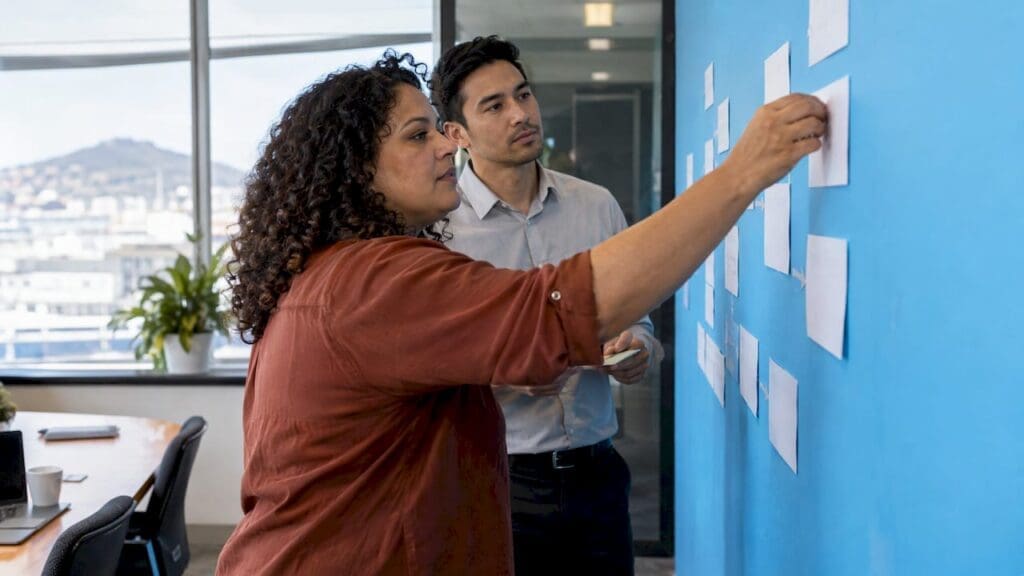
Business.govt.nz recommends process mapping to study how a business works. A process map can record the time or cost of each step, who does it, the decision rules, sources of errors and links to other processes. That turns a vague sense that “this takes too long” into a list of specific steps you can improve.
When you map a process, look for:
- Waiting: work sitting in an inbox or approval queue.
- Rework: errors caught late and fixed by hand.
- Handoffs: each time work moves between people or systems, delay and error risk rise.
- Duplicate entry: the same data keyed into two or three systems.
- Over-processing: checks, reports and approvals nobody uses.
Our guides on finding and fixing process bottlenecks and on operational efficiency improvement go deeper on each of these.
Why trained people make the difference
Mapping a process is easy to start and hard to finish well. The teams that sustain savings tend to share a method and a vocabulary. Lean focuses on removing waste, and Six Sigma on reducing variation and defects. Together, Lean Six Sigma gives a team a structured way to define a problem, measure it, find the cause, fix it and hold the gain.
We train organisations in these methods at several levels, so the right people get the right depth:
| Role | Course | Published price |
|---|---|---|
| Leaders sponsoring improvement | Lean for Leaders – Sponsors and Champions | from NZ$495 |
| Everyone in the team | Certified Lean White Belt Optimisation Foundation | from NZ$795 |
| Team members running improvements | Certified Lean Six Sigma Yellow Belt | from NZ$1,500 |
| Project leaders | Certified Lean Six Sigma Green Belt | from NZ$3,345 |
Prices are per person and as published on our site; see the Lean Six Sigma page for the current details.
The sponsor level matters more than it looks. Improvement projects stall when leaders do not clear obstacles or protect time, and a leader who understands the method asks better questions about the savings being claimed.
Step 4: Use digital tools where the process is already sound
Automation is one of the most commonly cited ways to reduce operating costs, and for good reason. Manual invoicing, approvals, data re-entry and reporting consume hours that add no value for your customer. Xero’s NZ guide, for example, points to automating invoicing, bank reconciliation, payroll and expense tracking as a way to cut overtime and lift productivity.
The order matters. Automating a broken process only makes the problem faster. Map and simplify first, then automate what remains. Our guides on digital workflow solutions and digital transformation consulting explain how to connect systems and remove manual handoffs once the process is clear.
Do not skimp on the investment where it counts. Farmers Weekly’s profile of the packhouse automation firm Mpac reports that its automation brought labour cost to about 50c per tray against an industry average of about $4.00, and that its leader warns cutting automation capital outlay is usually the worst mistake because back-up capacity is needed when equipment breaks down. The same article describes staff moving into higher-skilled permanent roles in automation, programming and maintenance. Good automation changes the work people do; it does not need to remove them.

Step 5: Protect quality while you cut
The risk in any cost programme is saving money in a way that costs you customers. Three habits reduce that risk.
Score each idea for impact on revenue, customers and people. An idea that saves $20,000 but puts a $200,000 client at risk is not a saving. Sequence low-risk ideas first.
Keep capability. Cutting training and improvement time to meet a budget target often raises costs later, through errors, turnover and slow decisions. Building skills is how a team keeps finding savings without outside help.
Revisit assumptions. The Office of the Auditor-General’s guidance on value for money, written for public organisations but useful for any, says organisations that manage it well revisit assumptions, track performance and adjust when evidence shows the current approach is not working. Check each change against the outcome you intended.
Use a framework for the whole organisation
Some costs do not belong to one process. Unclear strategy, duplicated roles and poor coordination across teams all drive spending. The EFQM Model is an organisational framework used to assess how well an organisation performs across strategy, people, processes and results. We use it as the basis for our business assessment, which gives executives a structured view of strengths and gaps before they commit to a programme of change. Our EFQM courses build the skills to run that kind of assessment in-house, from the EFQM Model / Methodology Appreciation course at NZ$430 up to the 4-day Assessor Course from NZ$3,345.
Step 6: Measure the saving properly
A saving that cannot be shown is a saving the finance team will not believe. CIPS, the professional body for procurement and supply, defines a saving as a reduction in expenditure against a defined baseline, and says it should be quantifiable, measurable, tangible, auditable and verifiable. It also says a true saving exists only when performance, through-life cost and timeliness stay unchanged. In other words, a cheaper product that fails sooner is not a saving.
In practice:
- Set the baseline first. Record the current cost, volume and quality of the process before you change it.
- Report against your accounts. CIPS recommends reporting in-year and full-year figures linked to the organisation’s accounts, and removing agreed forecast savings from budgets up front, so they are not quietly spent elsewhere.
- Use enough history. For energy, EECA’s measurement guidance suggests at least 12 months of monthly bills to set a baseline, then comparing against sector benchmarks, optimising, and measuring the change to sustain it.
- Review monthly. Business.govt.nz’s finance guidance recommends monthly budget reviews. Savings that are not tracked drift away.
A 90-day plan
| Period | Focus | Output |
|---|---|---|
| Weeks 1 to 2 | Group 12 months of spend; rank categories; record baselines | Top-spend list and baseline figures |
| Weeks 3 to 4 | Quick wins: subscriptions, supplier terms, energy | A first set of verified savings |
| Weeks 5 to 8 | Map the two or three highest-cost processes; find waste and rework | Process maps with time and cost per step |
| Weeks 9 to 12 | Fix, automate where sensible, train owners, set monthly tracking | Improvements in place and a savings report against baseline |
The first month usually pays for itself. The second and third months are where lasting change begins, and where having people trained in a shared method speeds things up.
What to do next
If your cost base is large and you are not sure which processes drive it, begin with an assessment. If you already know where the waste is, train the people who own those processes. If the work is manual and repetitive, simplify it, then connect your systems.
We cover all three from one place. Our business improvement work combines assessment, capability building and practical implementation support, delivered from a New Zealand perspective for organisations from small businesses to large corporates. You can also browse all our courses or read more in our insights library.
How Klicx can help
We help New Zealand organisations move from “we need to cut costs” to a plan they can carry out. That can mean a business assessment to show where performance and cost are being lost, Lean Six Sigma and EFQM training so your own people lead improvements, and digital solutions that connect workflows and systems. Pricing for consulting and digital work is agreed per project, and course prices are published on the courses page.

To discuss where to start, visit klicx.co.nz and tell us what is driving your costs.
Our perspective
Most cost programmes we hear about start with a number: cut ten per cent. The trouble is that a target says nothing about where the waste actually sits, so the cuts land wherever it is easiest to make them, often on training, maintenance and the people who hold the knowledge.
We prefer to start with how the work flows. Once a team can see its process, the waste is rarely a surprise: approvals that wait, data typed twice, checks nobody reads. Fixing those lowers cost and usually improves service at the same time.
That is why we combine assessment, capability building and implementation. An assessment shows where to look, training gives your people the method to fix it, and practical support helps the change stick. When a team has the skills, the next saving is one it finds itself.
Our advice: take the quick wins this quarter, and invest in capability so the savings keep coming next year.
Jeremy
FAQ
What are the most effective ways to reduce operating expenses?
Start with your largest spend categories, then take quick wins such as unused subscriptions, supplier terms and energy. After that, map and improve the processes that generate cost, and automate what is left. Process improvement tends to deliver the savings that last.
How do I decide what to review first?
Group 12 months of spend into categories and rank them. Review the largest ones and the processes behind them first, because a small percentage saving there is worth more than many small cuts elsewhere. Business.govt.nz’s operational efficiency guidance suggests looking at raw materials, power, people and time, and at capital spending on equipment.
How can I cut costs without hurting service quality?
Score each idea for its effect on revenue, customers and staff before acting, and take low-risk ideas first. Keep investment in training and equipment that supports quality. A genuine saving leaves performance unchanged.
How do I know a saving is real?
Compare it with a baseline you recorded before the change, report it against your accounts, and review it monthly. If quality, timeliness or through-life cost got worse, the saving is not real.
Can small businesses use Lean Six Sigma to reduce costs?
Yes. The methods scale from a small team improving one process to a large organisation running many projects. Our White Belt and Yellow Belt courses are designed for staff who need practical skills without leading a major project.
Sources
- Cost reduction strategies: how businesses can save money (ASB)
- Reduce energy costs and emissions (Business.govt.nz)
- Upgrading heating, cooling and refrigeration equipment (EECA)
- New Zealand businesses shift focus from survival to growth (Scoop)
- Cost reduction strategy: 12 smart ways to cut costs (Xero NZ)
- Operational efficiency and innovation (Business.govt.nz)
- Finding the value in your business (Business.govt.nz)
- Process mapping (Business.govt.nz)
- Finance tips to help your business (Business.govt.nz)
- Machines do the talking for disruptor’s success (Farmers Weekly)
- Defining and assessing value for money (Office of the Auditor-General)
- Purchasing and supply management: savings (CIPS)
- Energy measurement (EECA)
Recommended
- Operational Efficiency Improvement: A Practical Guide for NZ Organisations
- Digital Workflow Solutions: A Practical Guide for NZ Organisations
- Process Bottlenecks: How to Find and Fix Them in Your Business
- Digital Transformation Consulting for NZ Organisations
This article was produced with AI assistance and reviewed for accuracy. It is provided for general information only and is not professional advice.