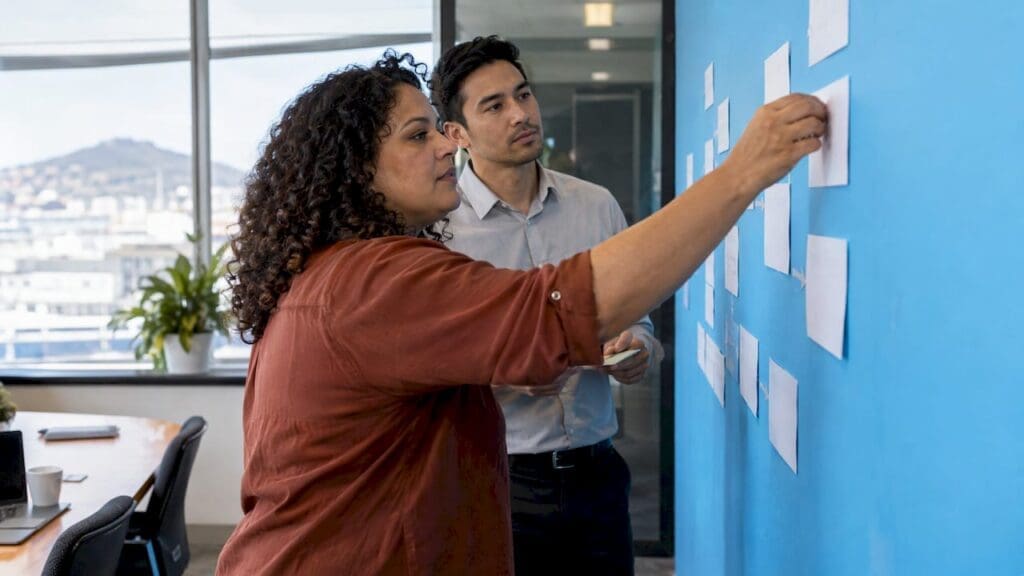
Continuous improvement consulting is outside help to find where your organisation loses time, money or quality, fix it with a structured method, and leave your people able to keep doing it. The best engagements join three things: an honest assessment, staff training, and support to put changes into practice. That is the combination we deliver at Klicx, using the EFQM framework and Lean Six Sigma training for New Zealand organisations.
This guide explains what a consultant does, how improvement is implemented from the first problem to the measured result, how to build a culture that sustains it, and how to choose support.
TL;DR
- Continuous improvement is a repeating cycle: find a problem, understand its cause, test a fix, standardise it, then start again.
- A consultant is most useful when the work includes assessment, training and implementation, so your own people own the result.
- Culture follows leadership signals and systems: clear ownership, regular measures and skills people can use.
- Training in EFQM and Lean Six Sigma gives managers and teams a shared method and language.
- Start with a baseline of current performance so you can show what changed.
Table of Contents
- What continuous improvement consulting involves
- How to implement continuous improvement, step by step
- Building a continuous improvement culture
- Training that keeps improvement going after the project ends
- How to choose improvement support
- Working with Klicx
- Our perspective
- FAQ
- Sources
What continuous improvement consulting involves
Continuous improvement means making many small, steady changes to how work is done, rather than waiting for one large transformation. A consultant brings a method, an outside view and the capacity to run the work while your managers keep running the business.
In practice the work usually falls into four parts:
- Assessment. Establishing where the organisation stands today, across strategy, leadership, people, processes and results.
- Prioritisation. Choosing the problems worth fixing first, based on business value rather than whoever complains loudest.
- Capability building. Training staff so they can run improvement projects themselves.
- Implementation support. Helping teams pilot, embed and measure changes, including digital workflow and systems changes where the process needs them.
The EFQM Model is one of the frameworks used for the first step. Its 2025 edition says that baselining current performance can start the journey towards a continuous improvement mindset, reinforced by regular checkpoints to monitor progress. A baseline matters for a plain reason: without one, nobody can say whether a change helped.
If you want the wider picture of how improvement consulting differs by focus, our guides on performance improvement consulting and organisational effectiveness consulting go further.
How to implement continuous improvement, step by step
The process below follows the approach described by APQC, a nonprofit benchmarking and research body. Each step shows what it takes and where it usually goes wrong.

Step 1: Find the opportunities
Start with evidence rather than opinion. APQC points to several complementary sources: performance data, employee input, customer and stakeholder feedback, process maps and reviews of handoffs, rework, delays, exceptions and recurring errors.
Where it goes wrong: relying only on the loudest manager’s view, or collecting data nobody acts on. Ask the people who do the work where the pain is. They usually know.
A good starting point is a hard look at where work queues up. Our guide to finding and fixing process bottlenecks shows how.
Step 2: Prioritise by value
You will find more problems than you can fix. Rank them by business value and effort. The Plan stage of the PDCA cycle (Plan, Do, Check, Act), as UC Irvine frames it, includes mapping the current state, defining a goal and prioritising with an impact and effort matrix, a simple grid that compares how much a fix would help with how hard it is to do.
Where it goes wrong: starting with the easiest fix that matters least, or taking on five projects when the team has capacity for one.
Step 3: Analyse the root cause
Design nothing until you know why the problem happens. Tools such as the Five Whys (asking “why” repeatedly until you reach the underlying cause) and the fishbone diagram (a chart that sorts possible causes into categories) are standard here.
Where it goes wrong: treating a symptom. If a report is late every month, a faster report template will not help if the real cause is that data arrives late from another team.
Step 4: Pilot the fix
Test the change at an appropriate scale before rolling it out. Collect data during the pilot. The IAEA, the UN nuclear agency, recommends in its continual improvement guidance that organisations consider running old and new processes in parallel until the new one is proven. That caution suits any organisation where a failed change would hurt customers.
Where it goes wrong: skipping the pilot because the fix looks obvious.
Step 5: Implement with owners, training and measures
The same IAEA guidance says the improved process should be fully implemented only once supporting documentation such as procedures, policies and training programmes is in place. It also says the process owner should make sure staff are competent and supportive. APQC adds clear ownership, communication and defined measures.
Where it goes wrong: announcing the change by email and assuming it has happened. This is the step where training pays for itself, because a new process only works when the people using it know how.
Step 6: Check, standardise and go again
Compare results against your baseline and target. If the target is met and the root cause is gone, standardise the new way of working, then start a new cycle. The IAEA also recommends monitoring SMART measures (specific, measurable, achievable, relevant and time-bound) against expected results, and recording lessons learned for future projects.
Where it goes wrong: declaring victory at go-live and never checking again. Improvement that is not measured tends to drift back.
Building a continuous improvement culture
Culture is the habit of noticing problems and fixing them without being told. It is the part most organisations find hardest, and it cannot be bought as a one-off project.
A New Zealand example shows what the groundwork looks like. NZ Manufacturer reports that Formthotics built a learning programme for its 17 operators covering wellbeing, communication, teamwork, values, goal-setting and problem-solving. The results included fewer avoidable mistakes, less waste and staff speaking up before problems grew. The article describes conversations shifting from “that’s not my job” towards how things could be made better, with quieter staff starting to contribute. The driver was leadership showing clearly that people mattered.
A peer-reviewed 2024 case study in a medical technology organisation points the same way from the systems side. It found that a structured, phased PDCA-based model with ways to measure improvement activity gave a sustainable foundation for a wider improvement culture. In that study, 24 of 30 participants (80%) responded positively to the step-by-step model.
Three practical moves follow from this:
- Leaders go first. Sponsors and champions who understand the method, and ask about improvement in regular meetings, set the tone.
- Give people a method. Staff who know how to map a process and find a root cause contribute more than staff who are only asked for ideas.
- Make progress visible. Regular checkpoints and simple measures show people their effort counts.
Communication and ownership plans do much of the work of making changes stick. This piece on change management in practice shows how a clear plan helps people adopt a new way of working.
Training that keeps improvement going after the project ends

Most improvement gains are lost when the project team disbands and nobody knows how to carry on. Training your own people is the way to keep the capability in house. It also gives managers, project teams and executives a shared vocabulary, which makes projects faster to start and easier to review.
Our courses are priced per person, and cover two methods:
| Course | Who it suits | Price |
|---|---|---|
| Lean for Leaders: Sponsors and Champions | Executives and managers who sponsor improvement | from NZ$495 |
| Lean White Belt Optimisation Foundation | Frontline staff new to improvement | from NZ$795 |
| Lean Six Sigma Yellow Belt | Team members who support projects | from NZ$1,500 |
| Lean Six Sigma Green Belt | Staff who lead improvement projects | from NZ$3,345 |
| EFQM Foundation, Fast Track | Managers who need the EFQM Model quickly | from NZ$795 |
| EFQM Foundation, In-Depth | Teams working with the model in detail | from NZ$1,500 |
| EFQM Assessor Course (4 Day) | Staff who will assess organisational performance | from NZ$3,345 |
Lean Six Sigma, in short, combines Lean (removing waste from a process) with Six Sigma (reducing variation and defects), and the belt levels run from awareness to project leadership. A sensible pattern is to train sponsors first, then a group of project leaders, then spread the foundation level more widely. See the full list on our courses page.
How to choose improvement support
Whatever route you take, judge support on these points:
- Does it start with an assessment? Fixing the wrong problem wastes the budget.
- Does it build your people’s skills? The aim is that your team can run the next cycle without help.
- Does it cover implementation? Plans that stop at a report rarely change how work is done.
- Does it fit your context? A New Zealand organisation of 30 people and a national corporate face different constraints, and the approach should flex.
- Does it connect strategy, process and systems? Digital workflow changes should follow from the process work, not lead it. For the strategy side, see our guide to business strategy consulting in NZ.
Working with Klicx
We support the whole improvement journey in one place: business assessment, EFQM assessment support, Lean Six Sigma and EFQM training, innovation and project management support, and digital solutions for workflow and systems integration. Our business improvement service is delivered with a New Zealand perspective, for organisations from small businesses to large corporates.

If you are deciding where to begin, a business assessment is the natural first step because it sets the baseline everything else is measured against. Start at our business assessment page or see what we do.
Our perspective
Most organisations we meet do not lack ideas. They lack a clear picture of where they stand, a shared method and the confidence to act on it.
That is why we combine EFQM assessment, capability building and practical implementation. The assessment shows where to focus. Training in Lean Six Sigma and EFQM gives your people the skills to lead the work. Implementation support, including digital solutions, turns plans into changed processes.
Improvement that lives with your own people lasts. Sponsors who understand the method, project leaders who are trained to use it and measures that are reviewed regularly are what turn a project into a habit.
If you take one step this quarter, baseline your performance and train the people who will lead the next cycle.
Jeremy
FAQ
What does a continuous improvement consultant do?
A consultant assesses how your organisation works, identifies the problems worth solving, and applies a method such as PDCA, Lean or Six Sigma to fix them. Good consultants also train your staff and help embed the changes so results are measured and sustained.
How long does it take to build a continuous improvement culture?
There is no fixed timeline, because culture shifts as leaders, systems and skills change together. Starting with a baseline and regular checkpoints, as the EFQM Model suggests, lets you see progress over time rather than waiting for a single result.
Where should a small organisation start?
Pick one problem that matters to customers or costs, map the process, find the root cause and pilot a fix. Training a few people at foundation level gives them the vocabulary and tools to repeat that cycle.
Which training suits managers and executives?
Sponsors and champions benefit from our Lean for Leaders course, from NZ$495, which focuses on their role in backing improvement. Managers who want the EFQM Model can take the Foundation Course, from NZ$795 in the Fast Track format.
Sources
- APQC: What Is the Continuous Improvement Process
- IAEA: Management of continual improvement for facilities and activities (TE-1491)
- EFQM Model 2025
- NZ Manufacturer: Before the robots arrive, how Formthotics prepared its staff
- Naughton et al. (2024): A structured model for continuous improvement methodology
Recommended
- Organisational Effectiveness Consulting: What It Is and How to Choose
- Performance Improvement Consulting: What It Is and How to Use It
- How to Improve Service Quality in a NZ Organisation
- Operational Efficiency Improvement: A Practical Guide for NZ Organisations
This article was produced with AI assistance and reviewed for accuracy. It is provided for general information only and is not professional advice.